Education and VR&E
VR&E or the Post-9/11 GI Bill
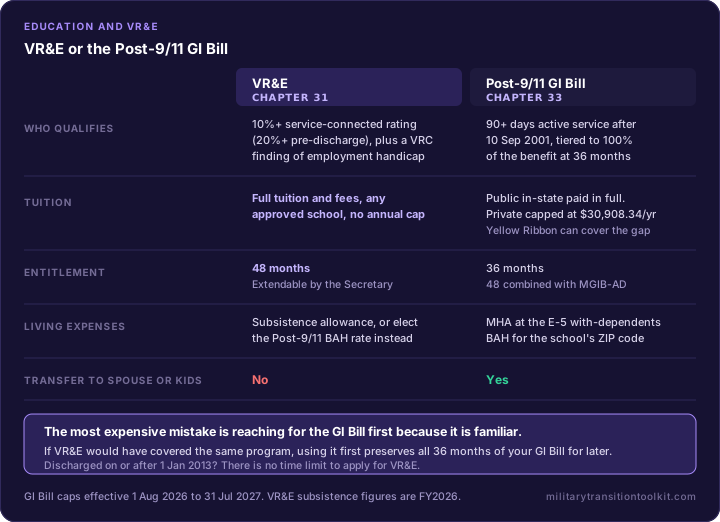
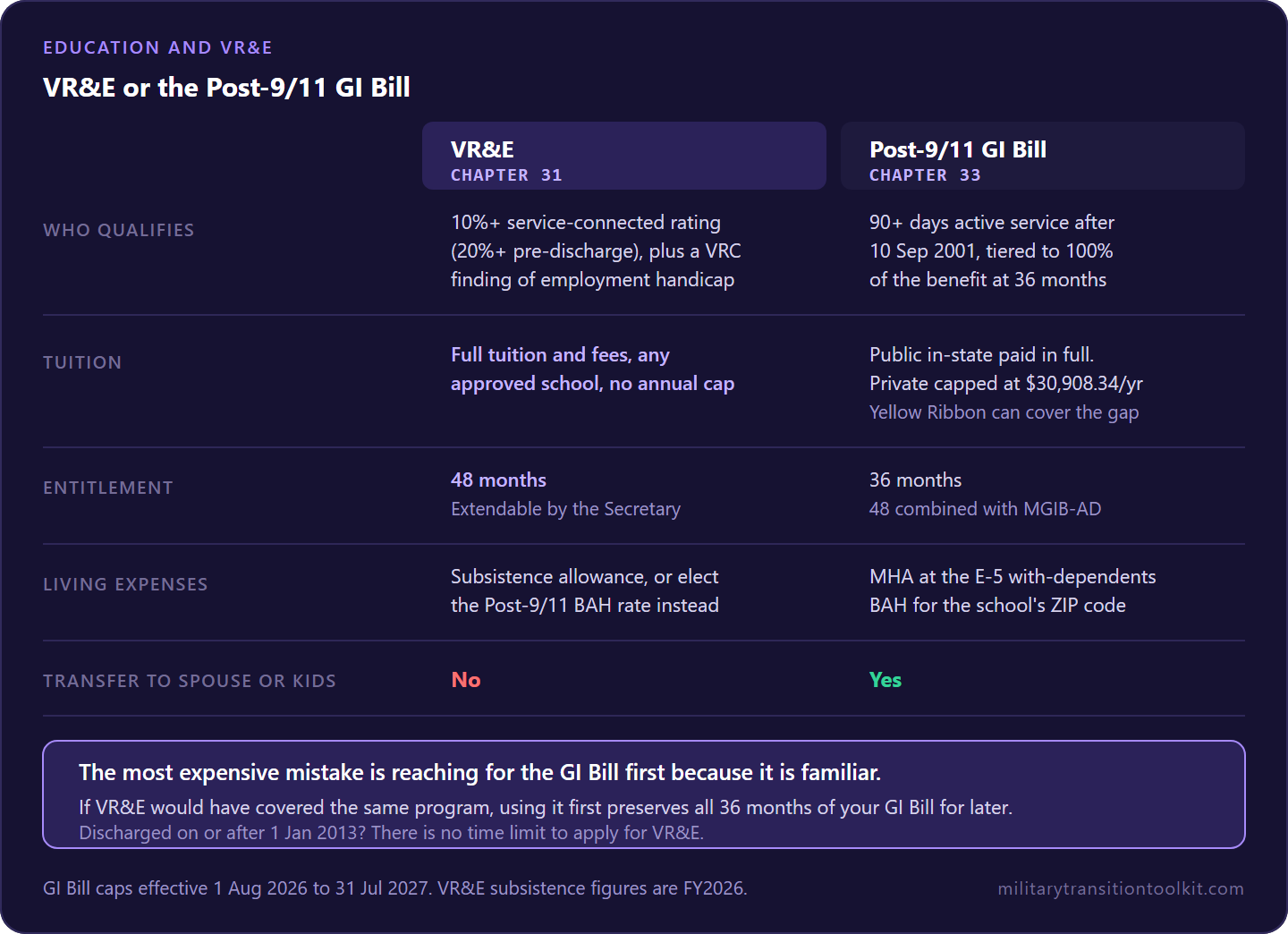
Eligibility, tuition, entitlement, living expenses and transferability side by side, and why order of use is the expensive decision.
You can use this
Put it in a brief, a TAP class, a unit newsletter, a VSO handout or your own site. No permission needed and nothing to fill out. Credit it with a link so readers can find the source and check the numbers themselves. Do not sell it on its own, and do not edit the figures and leave our name on it.
The PNG is the one to use for slides, email and anything that will not render an SVG. Grab the SVG if you need it sharp at any size.
Source: VR&E or the Post-9/11 GI Bill — Military Transition Toolkit (https://www.militarytransitiontoolkit.com/diagrams/vre-vs-gi-bill-comparison)
<figure>
  <img src="https://www.militarytransitiontoolkit.com/diagrams/vre-vs-gi-bill-comparison.png"
       alt="VR and E Chapter 31 compared with the Post-9/11 GI Bill Chapter 33. On eligibility, VR and E needs a service-connected rating of at least 10 percent, or 20 percent or higher pre-discharge, plus a counselor's finding of an employment handicap; the Post-9/11 GI Bill needs 90 days or more of active service after 10 September 2001, tiered up to 100 percent of the benefit at 36 months. On tuition, VR and E pays full tuition and fees at any approved school with no annual cap, while the GI Bill pays public in-state in full but caps private schools at 30,908 dollars 34 cents per academic year, with Yellow Ribbon able to cover the gap. On entitlement, VR and E gives 48 months, extendable by the Secretary, against 36 months under the GI Bill, or 48 combined with the Montgomery GI Bill. On living expenses, VR and E pays a subsistence allowance or the elected Post-9/11 BAH rate, while the GI Bill pays a monthly housing allowance at the E-5 with-dependents BAH for the school's ZIP code. VR and E cannot be transferred to a spouse or children; the Post-9/11 GI Bill can. The most expensive mistake is reaching for the GI Bill first because it is familiar, when using VR and E first would have covered the same program and preserved all 36 months of GI Bill for later. If you were discharged on or after 1 January 2013 there is no time limit to apply for VR and E."
       width="720" height="522">
  <figcaption>
    VR&E or the Post-9/11 GI Bill. Source:
    <a href="https://www.militarytransitiontoolkit.com/diagrams/vre-vs-gi-bill-comparison">Military Transition Toolkit</a>
  </figcaption>
</figure>
Where this comes from
This diagram is drawn from VR&E vs the GI Bill: which to use, which cites the regulations and rate tables behind every figure shown here. If a rate changes, the guide and the diagram are updated together.