VR&E vs GI Bill (2026): Why VR&E Usually Wins
With a 10%+ rating, VR&E almost always beats the Post-9/11 GI Bill, and using it first preserves your GI Bill. The 2026 comparison.
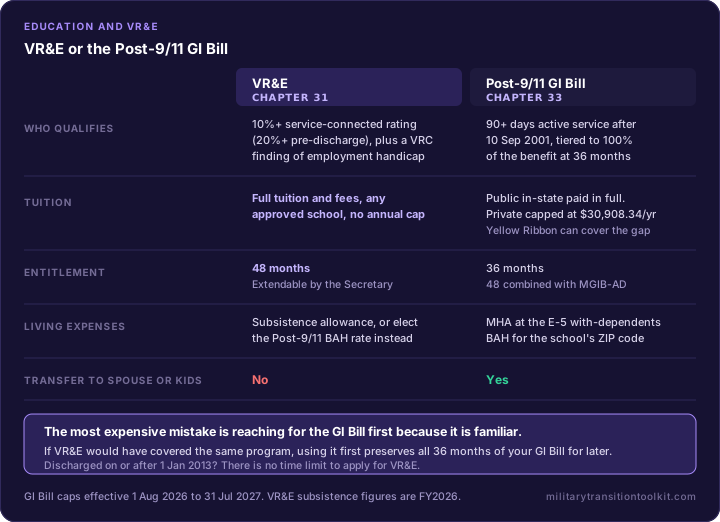
If you have a service-connected disability rating of 10% or higher and an employment handicap, VR&E (Chapter 31) almost always beats the Post-9/11 GI Bill: it pays full uncapped tuition, gives 48 months of entitlement instead of 36, and can pay Post-9/11 BAH-rate housing via Form 28-0987 without charging your GI Bill. Using VR&E first preserves your full GI Bill for later or to transfer to a spouse or children.
If you have a service-connected disability rating of 10% or higher and an employment handicap, VR&E (Chapter 31) almost always beats the Post-9/11 GI Bill, uncapped tuition, longer entitlement, and using it first preserves your GI Bill for later.
Most veterans get this backwards. They use the GI Bill because they've heard of it, then realize after they've burned 36 months of entitlement that VR&E would have covered the same program for free with better living expenses and let them keep the GI Bill for their kids.
This guide is the side-by-side comparison, the FY2026 rate tables, and the scheduling rule that changes the math entirely. To run your own numbers, use our VR&E vs GI Bill comparison tool.
Quick verdict
| Your situation | Use this |
|---|---|
| 10%+ rating + employment handicap, planning grad school or expensive program | VR&E first, GI Bill if needed after |
| 10%+ rating but program fits in 36 months at an in-state public school | Either works; VR&E pays more in living expenses for most metros |
| No service-connected disability (or under 10%) | Post-9/11 GI Bill |
| Want to transfer benefits to a spouse / kids | Post-9/11 GI Bill (VR&E is not transferable) |
| You've already used VR&E and need more education | Post-9/11 GI Bill |
The single biggest mistake transitioning veterans make: starting with the GI Bill because it's familiar, when VR&E would have covered the same program and preserved the GI Bill.
VR&E (Chapter 31) at a glance
VR&E, formally called Veteran Readiness and Employment, also known as Chapter 31, "helps you explore employment options and address education or training needs" if your service-connected disability "limits your ability to work or prevents you from working." (va.gov/careers-employment/vocational-rehabilitation/)
Eligibility
- Veterans: service-connected disability rating of at least 10% from VA
- Active-duty service members: 20% or higher pre-discharge memorandum rating
- Discharge other than dishonorable
- A Vocational Rehabilitation Counselor (VRC) determines you have an employment handicap, your disability impairs your ability to prepare for, obtain, or maintain suitable employment
Time limit to apply
If you were discharged on or after January 1, 2013, there's no time limit. The "Forever VR&E" rule. If you were discharged before that, the standard limit is 12 years from notice of separation or first VA rating, whichever is later (extendable for serious employment handicap). (VA eligibility)
What VR&E pays for
When the VRC approves a long-term services plan, VR&E pays:
- Full tuition and fees at any approved school, no annual cap, unlike the GI Bill private-school cap
- Books, supplies, equipment required for the program
- Monthly subsistence allowance (housing/living)
- Tutoring, certification/license fees, tools, work clothing
- Vocational counseling and job-placement support
Entitlement
48 months of educational assistance under Chapter 31. The Secretary of VA may extend this period if needed to achieve the vocational goal. (va.gov/education/eligibility/)
The five tracks
VR&E isn't one program, it's five. Most education-focused veterans use Track 4. (va.gov/.../programs/)
- Reemployment, return to your former job
- Rapid Access to Employment, leverage existing skills, fast job search
- Self-Employment, start a business
- Long-Term Services, education/training to enter a different field, the track most VR&E education recipients use
- Independent Living, for veterans not yet ready to return to work
VR&E Subsistence Allowance: FY2026 Rate Table
Effective October 1, 2025. Source: VR&E FY26 rates.
Standard Chapter 31 subsistence, institutional training
| Training time | No deps | 1 dep | 2 deps | Each add'l |
|---|---|---|---|---|
| Full-time | $812.84 | $1,008.24 | $1,188.15 | $86.58 |
| ¾ time | $610.76 | $757.28 | $888.32 | $66.60 |
| ½ time | $408.66 | $506.32 | $595.16 | $44.42 |
| ¼ time | $204.30 | $253.20 | $297.59 | $22.16 |
Farm Co-op / Apprenticeship / OJT (full-time)
$710.67 (no dep) | $859.43 (1) | $990.47 (2) | $64.41 each add'l.
The Post-9/11 BAH election (the option most veterans should take)
If you also qualify for the Post-9/11 GI Bill, you can elect to receive your VR&E subsistence at the BAH rate for an E-5 with dependents at the ZIP code of your school. File VA Form 28-0987.
For most metro areas, the BAH election is $2,000–$4,500/month, significantly higher than the standard rate. (VBA Subsistence Allowance Rates) You can estimate your own figure with our VR&E subsistence calculator.
Important: Electing the Post-9/11 BAH rate does NOT charge entitlement against your Post-9/11 GI Bill. You still get all 36 months of the GI Bill back later if eligible.
This is the magic combination, VR&E pays for school, you take the higher BAH rate as living expenses, and your GI Bill stays intact for later.
Post-9/11 GI Bill (Chapter 33) at a glance
For comparison. (va.gov/.../post-9-11/)
Tuition (effective 8/1/2026–7/31/2027)
- Public in-state schools: full net tuition and mandatory fees
- Private/foreign schools: capped at $30,908.34 per academic year
- Yellow Ribbon Program, at participating schools, can cover the gap above the cap
Monthly Housing Allowance (MHA)
Based on E-5-with-dependents BAH at the school's ZIP code, prorated by your eligibility tier and rate of pursuit.
- Online-only students: capped at $1,261/month
- Foreign schools: capped at $2,522/month
Books and supplies stipend
Up to $1,000/year, paid as $41.67/credit hour up to 24 credits/year.
Entitlement
36 months. (Up to 48 months combined if eligible for both Post-9/11 and Montgomery GI Bill-AD.)
Eligibility tiers
| Active-duty service after 9/10/2001 | % of full benefit |
|---|---|
| 36+ months | 100% |
| 30-35 months | 90% |
| 24-29 months | 80% |
| 18-23 months | 70% |
| 6-17 months | 60% |
| 90 days-5 months | 50% |
| Purple Heart (any length post-9/11) | 100% |
| Discharged for service-connected disability after 30+ continuous days | 100% |
Time limit
If your service ended on or after January 1, 2013, your benefits don't expire (Forever GI Bill). Otherwise, 15-year delimiting date.
Transferable to dependents
Yes. Service requirements (6 years served + 4-year additional obligation) administered by DoD. (Transfer guide)
Side-by-side comparison
| Factor | VR&E (Ch 31) | Post-9/11 GI Bill (Ch 33) |
|---|---|---|
| Tuition cap | None (any approved school) | In-state public: full / private: $30,908.34/yr |
| Monthly living stipend | Standard rate OR Post-9/11 BAH election | E-5-w/dep BAH × eligibility % |
| Books / supplies | Actual cost paid by VA | $1,000/yr cap |
| Entitlement | 48 months (extendable) | 36 months |
| Transferable to dependents | No | Yes |
| Eligibility gate | 10%+ rating + employment handicap | 90+ days post-9/10/2001 service |
| Cost to entitlement | Doesn't reduce GI Bill if you elect P9/11 BAH | Counts against 36 months |
| Approval process | VRC interview + plan + can be denied | Mostly automatic if eligible |
| Time limit | None if discharged on/after 1/1/2013 | None if service ended on/after 1/1/2013 |
The 48-month combined cap (and the magic exception)
Free tool for this exact situation
GI Bill, state tuition waivers, and VR&E — compared by state.
Per VA.gov:
"If you're eligible for more than 1 education benefit, you may be able to get up to a maximum of 48 months (or 4 years) of VA education benefits. This doesn't include Veteran Readiness and Employment (VR&E) benefits (Chapter 31) [in the cap]... if you use VR&E benefits first, we won't deduct entitlement from your other VA education benefits, like the Post-9/11 GI Bill."
Translation: Use VR&E first, GI Bill second. This is the single most valuable scheduling decision a 10%+ rated veteran can make.
The technical limit is still 48 months total of VA education assistance under Chapters 31 + 33 combined, but the "use VR&E first" rule means you can finish a long program (like a PhD or professional degree) on the GI Bill after VR&E expires without losing your full GI Bill entitlement to start with.
Scenarios where VR&E wins
- You have a 10%+ rating and a clear employment handicap
- Your program costs more than the $30,908.34 GI Bill private cap (PA school, nursing BSN at private universities, MBA, law school, DPT)
- You'd otherwise burn GI Bill on books, fees, certifications, equipment
- You're eyeing a longer program (more than 36 months: PhD, professional degrees)
- You want to preserve GI Bill for your spouse or kids
Scenarios where the GI Bill wins
- You don't have a service-connected disability (or under 10%)
- Your VRC denies you ("you can already work in your field")
- You want to transfer benefits to a spouse or child
- You're attending an in-state public school where tuition is already fully covered, and the standard GI Bill housing allowance covers your area
- You've exhausted VR&E
How to apply for VR&E
Submit VA Form 28-1900:
- Online at va.gov/careers-employment/vocational-rehabilitation/how-to-apply/
- By mail to the VR&E intake center in Janesville, WI
- In person at any VA Regional Office
- Through a Veteran Service Officer (VSO)
After applying, VA schedules an appointment with a Vocational Rehabilitation Counselor (VRC). The VRC evaluates whether you have an employment handicap and, if eligible, helps you build a rehabilitation plan called an Individual Written Rehabilitation Plan (IWRP).
VRC appointment timing typically runs 30-90 days from application, depending on regional office workload. (VA does not publish this timeline officially, that's industry observation.)
Common pitfalls
1. Starting with the GI Bill out of habit. The biggest leak. Use VR&E first.
2. Not applying for VR&E because "I'm not a wounded warrior." Wrong frame. 10% is the floor, many transition veterans qualify (tinnitus alone is often a 10% rating). The "employment handicap" requirement is broader than people assume; the disability just has to impair your ability to do your prior work or your career goal.
3. Not electing the Post-9/11 BAH rate. The form is VAF 28-0987. Without it you get the standard rate (~$813/mo full-time, no deps). With it you get the local BAH rate ($2,000-$4,500/mo in most metros). It's free entitlement preservation; don't skip it.
4. Settling for a denied claim. First denials are common. VRC interpretations of "employment handicap" vary by counselor and region. Appeal through the VR&E appeal process or request a different VRC. Don't accept the first no.
5. Waiting to apply. VR&E benefits aren't retroactive, months you spend in school before approval don't get reimbursed.
6. Missing the IWRP. The Individual Written Rehabilitation Plan is the document that lists what VR&E will pay for. If a cost isn't in your IWRP (lab fees, equipment, exam fees), it won't be reimbursed. Get every expected cost included before you enroll.
Frequently Asked Questions
Should I use VR&E or the GI Bill first?
Use VR&E first if you have a 10%+ rating and an employment handicap. Because VR&E benefits don't count against the Post-9/11 GI Bill when used first, this preserves your full 36 months of GI Bill for later use or to transfer to dependents.
Does using VR&E use up my GI Bill?
No, not if you elect the Post-9/11 BAH rate with VA Form 28-0987. Electing that housing rate does not charge entitlement against your Post-9/11 GI Bill, so your 36 months stay intact.
What disability rating do I need for VR&E?
Veterans need a service-connected disability rating of at least 10% plus an employment handicap determined by a Vocational Rehabilitation Counselor. Active-duty members applying pre-discharge need a 20% or higher memorandum rating.
Can I transfer VR&E benefits to my spouse or kids?
No. VR&E is not transferable. If transferring education benefits to dependents matters to you, that is a reason to preserve the Post-9/11 GI Bill, which is transferable.
When does the GI Bill beat VR&E?
The GI Bill is the better choice if you have no service-connected disability (or under 10%), your VRC denies you, you want to transfer benefits to a spouse or child, you've already exhausted VR&E, or you're at an in-state public school where tuition is fully covered and the standard housing allowance covers your area.
Can I use both VR&E and the GI Bill at the same time?
No. You cannot draw VR&E (Chapter 31) and the Post-9/11 GI Bill (Chapter 33) simultaneously, but you can use them sequentially. The recommended order is VR&E first, then the GI Bill, because entitlement used under VR&E is not deducted from your Post-9/11 GI Bill when you use VR&E first. Both programs still count toward the 48-month combined VA education cap.
Can I use VR&E after I've already used my GI Bill?
Yes. Using the GI Bill first does not disqualify you from VR&E, as long as you meet the eligibility gate (a 10%+ service-connected rating plus an employment handicap) and have remaining entitlement under the 48-month combined cap. The catch is that GI Bill months you've already used count against that 48-month total, so you have fewer VR&E months left. This is why using VR&E first is almost always the better order for a rated veteran.
Does VR&E cover graduate school or a master's degree?
Yes. VR&E can fund a master's or other graduate degree when the VRC agrees that degree is required to reach a suitable vocational goal given your disability. It is not automatic: if a bachelor's degree already makes you employable in your field, the counselor can consider you rehabilitated and decline further funding. Declare your full educational goal (for example, "I need the master's to work as X") when you apply, not after you finish the bachelor's.
Is there a time limit to use VR&E?
If you were discharged on or after January 1, 2013, there's no delimiting date, the "Forever VR&E" rule, and you can apply at any point. If you separated before that date, the older 12-year limit (from your date of separation or first VA rating, whichever is later) generally applies, though it can be extended for a serious employment handicap. Separately from any deadline, VR&E provides 48 months of entitlement, which VA can extend when needed to complete your vocational goal.
Can I receive VR&E and VA disability compensation at the same time?
Yes. The VR&E subsistence allowance is paid in addition to your monthly VA disability compensation, not instead of it. The two are separate benefits, so a rated veteran in an approved VR&E program collects both the disability check and the subsistence (or elected BAH-rate) payment each month. Participating in VR&E does not reduce your disability rating or compensation.
What to remember
The math is straightforward: if you have a 10%+ rating and an employment handicap, VR&E pays better than the Post-9/11 GI Bill in almost every dimension. It pays full tuition (no cap), longer entitlement (48 vs 36 months), better living expenses (with the BAH election), books and equipment at actual cost, and it doesn't burn your GI Bill.
The catch: VR&E requires VRC approval and the application process is slower and less automatic than the GI Bill. But the reward, an extra benefit worth $30,000-$100,000+ depending on your program, plus preserving the full GI Bill, is enormous.
If you've separated with a service-connected rating and you haven't at least applied for VR&E, that's the next move. The application is VA Form 28-1900. The conversation with a VRC is free. The downside is a denial, which is appealable.
A VSO (DAV, VFW, American Legion, or your state veterans affairs office) can help with the application at no cost. See our VSO vs Claims Agent vs Attorney guide if you're not sure which route to take.
Apply for VR&E: va.gov/careers-employment/vocational-rehabilitation/how-to-apply/, VA Form 28-1900.
FY26 subsistence rates: benefits.va.gov/vocrehab/vrerates26.asp
The 48-month combined cap rule: va.gov/education/eligibility/
Sources: VA VR&E (Chapter 31), VA education benefits (GI Bill).
Military Transition Toolkit — free
Compare VR&E and the GI Bill for your situation
VR&E vs GI Bill Comparison
See which benefit pays more for your situation
VR&E Subsistence Calculator
Estimate your monthly Chapter 31 subsistence by training time and dependents
All tools are 100% free. Create a free account to access account tools.
Related articles
What Is VR&E? Veterans Readiness and Employment (Chapter 31), Explained
Never heard of VR&E? Veterans Readiness and Employment (VA Chapter 31) can pay full tuition, a monthly living allowance, tools, and career help for service-connected veterans, and it doesn't touch your GI Bill. Here's what it is and how to know if you qualify.
Education & BenefitsVET TEC 2.0 (2026): Eligibility, Benefits, and How It Uses Your GI Bill
VET TEC 2.0 pays for veteran tech training in coding, data, and IT. 2026 eligibility, what it covers, how to apply, and how it now uses your GI Bill.
Education & BenefitsVET TEC 2.0 vs VR&E vs GI Bill: The Best Veteran Benefit for a Tech Career (2026)
VET TEC 2.0, VR&E, and the Post-9/11 GI Bill compared for a coding bootcamp or tech career change. Which pays most and which protects your GI Bill.