VR&E Pay Chart 2026: Subsistence + BAH Rates (Chapter 31)
The full VR&E Chapter 31 pay chart for 2026: $812.84/mo full-time single up to $1,188.15 with two dependents, plus how the BAH-equivalent election pays 2-4x more.
The FY2026 VR&E (Chapter 31) standard subsistence allowance (effective Oct 1, 2025) is $812.84/month full-time with no dependents, $1,008.24 with one dependent, and $1,188.15 with two dependents, plus $86.58 for each additional dependent. By filing VA Form 28-0987, you can instead elect the Post-9/11 BAH-equivalent rate (usually much higher) without burning any of your Post-9/11 GI Bill entitlement, which is why VR&E often beats the GI Bill cash-wise for service-connected veterans.
The VR&E (Chapter 31) subsistence allowance is the monthly payment veterans receive during approved training. It's the part of VR&E most service members don't understand, and it's the reason VR&E often beats the Post-9/11 GI Bill cash-wise for service-connected veterans.
This guide covers the FY2026 rates, the dependents math, and the critical BAH-equivalent election (VA Form 28-0987) that lets you take Post-9/11 BAH instead of the standard subsistence, without burning Post-9/11 entitlement.
Bottom line up front
- VR&E subsistence allowance is paid monthly during training, scaled by training time and dependents
- FY2026 standard rates (effective Oct 1, 2025): full-time single $812.84/mo, full-time +1 dep $1,008.24/mo, full-time +2 dep $1,188.15/mo
- The BAH-equivalent election (VAF 28-0987) lets veterans take Post-9/11 BAH instead, usually higher
- Critical: Filing 28-0987 does NOT burn Post-9/11 entitlement. The GI Bill stays intact for later use
- Combined cap: VR&E + Post-9/11 = 48 months total entitlement (38 USC § 3695)
VR&E pay chart 2026 (standard subsistence rates)
| Training Status | No Dependents | One Dependent | Two Dependents | Each Add'l Dep |
|---|---|---|---|---|
| Full-time | $812.84 | $1,008.24 | $1,188.15 | +$86.58 |
| 3/4 time | $610.76 | $757.28 | $888.32 | +$66.60 |
| 1/2 time | $408.66 | $506.32 | $595.16 | +$44.42 |
| Less than 1/2 time but more than 1/4 time (tuition only) | varies | varies | varies | , |
Rates increase with each cost-of-living adjustment (COLA). Source: VA VR&E Subsistence Allowance Rates.
Why these rates matter (the trap most veterans fall into)
Standard VR&E subsistence is significantly less than Post-9/11 GI Bill BAH for most veterans. A full-time VR&E student in San Diego with 2 dependents gets $1,188/mo subsistence. A full-time Post-9/11 GI Bill student at the same school gets ~$3,800/mo BAH (E-5 with-dependents BAH rate, ZIP-based).
If VR&E paid only the standard subsistence allowance, very few veterans would choose it over the GI Bill. But VR&E doesn't have to pay only the standard rate, that's where Form 28-0987 comes in.
The BAH-equivalent election: VA Form 28-0987
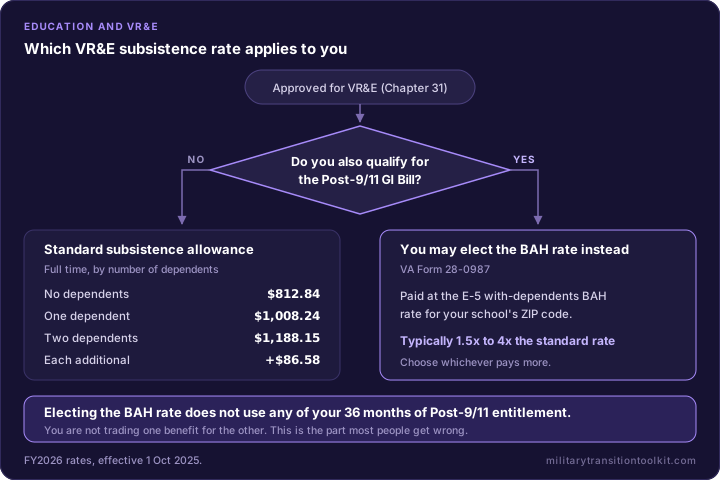
Form name: "Election for CH 31 Subsistence Allowance (CH31SA) Rate or Post 9/11 Subsistence Allowance (P911SA) Rate."
Purpose: allows a VR&E participant to elect the Post-9/11 monthly housing allowance rate instead of the standard subsistence allowance.
The math:
- Standard subsistence: $812-$1,188/mo full-time depending on dependents
- Post-9/11 BAH equivalent: BAH at the E-5 with-dependents rate for the school's ZIP code
For most major metros (San Diego, DC, Boston, NYC, Bay Area), Post-9/11 BAH is 2-4× the standard subsistence rate. For smaller markets, it's still typically 1.5-2× higher.
Critical mechanic: electing the BAH-equivalent under Form 28-0987 does not burn Post-9/11 entitlement. You're not using the GI Bill, you're using VR&E with a Post-9/11 BAH rate via election. The 36 months of Post-9/11 stay in your account for later use (master's degree, second career, etc.).
This is the single biggest reason VR&E beats Post-9/11 for service-connected veterans.
VR&E BAH rates: what the election actually pays
There is no separate "VR&E BAH table." When you elect the BAH-equivalent, VA pays the Post-9/11 GI Bill monthly housing allowance for your school's ZIP code, at the E-5 with-dependents rate — regardless of your actual rank or whether you have dependents. That single fact is what most people are looking for, and it means you can look up your exact figure from any Post-9/11 BAH rate table.
How the two options compare in practice, full-time enrollment:
| School location | Standard subsistence (no deps) | BAH-equivalent (E-5 w/deps) | Difference |
|---|---|---|---|
| San Diego, CA | $812.84 | ~$3,800 | ~4.7x |
| Washington, DC | $812.84 | ~$3,000 | ~3.7x |
| San Antonio, TX | $812.84 | ~$1,900 | ~2.3x |
| Rural / low-cost ZIP | $812.84 | ~$1,300 | ~1.6x |
BAH figures are approximate and change annually — verify your school's ZIP against the current year's rates. The pattern holds everywhere though: the BAH-equivalent election wins, and it wins biggest in high-cost metros.
Two limits worth knowing before you count on the higher number:
- Online-only enrollment pays roughly half the national average BAH, not your school's ZIP rate. This is the most common surprise.
- Less than half-time enrollment pays no housing allowance at all under either option.
Dependents math
The dependent count matters significantly. VR&E counts:
- Spouse (legally married, including same-sex marriages)
- Biological children under 18 (or under 23 if in school)
- Adopted children under 18 (or under 23 if in school)
- Stepchildren if living with the veteran
- Dependent parents if the veteran provides 50%+ support (VA Form 21-509 required)
Each additional dependent adds $86.58/mo to the standard full-time subsistence rate. Same proportional increase at part-time levels.
Don't claim dependents you can't document. VR&E will request VA Form 21-509 or marriage/birth certificates to verify dependent status. Misrepresentation triggers a stop-payment investigation.
Training time definitions
VR&E uses the same definitions as the Post-9/11 GI Bill for training time:
| Training Status | Hours per term (semester) |
|---|---|
| Full-time | 12+ undergrad credits, 9+ grad credits, OR 22+ clock hours/wk for vocational |
| 3/4 time | 9-11 undergrad credits, 7-8 grad credits |
| 1/2 time | 6-8 undergrad credits, 5-6 grad credits |
| Less than 1/2 | <6 undergrad / <5 grad, tuition + fees only, no subsistence |
Confirm training time with the school's VA Certifying Official (SCO) before enrollment. Training time at quarter-system schools converts differently, your SCO handles the math.
Subsistence during specific tracks
VR&E has 5 service tracks. Subsistence applies as follows:
| Track | Subsistence? | Notes |
|---|---|---|
| Track 1: Reemployment | Limited | Usually short-term, tied to existing job |
| Track 2: Rapid Access to Employment | Yes, during training | Typically 3-12 months |
| Track 3: Self-Employment | Yes, during plan development | Plus business equipment funding |
| Track 4: Long-Term Services | Yes, full duration | This is the big one, degree programs, healthcare programs |
| Track 5: Independent Living | Per VRC plan | Not employment-focused |
Track 4 is where most of the "VR&E for healthcare programs" and "VR&E for STEM degrees" subsistence math lives. See VR&E for PA School, Nursing, and Medical Programs.
Track 3 is the one the rate table understates. Self-employment pays subsistence while your business plan is being developed, and VR&E can fund equipment, licences, and supplies on top of it, which is a different calculation from a monthly housing figure. If that is the track you are considering, the numbers above are only the starting point: see the VR&E self-employment track for what the plan approval actually involves and what VA will and will not fund.
Tuition and fees on top of subsistence
Subsistence is the monthly housing/living payment. Separately, VR&E pays:
- All tuition and fees at any approved school, with no national maximum of the kind Post-9/11 applies to private and foreign schools
- All books and supplies required for the program
- Required tools/equipment for vocational programs
- Disability accommodations if needed (interpreters, assistive tech, etc.)
This is a real differentiator from the GI Bill, though it is worth stating the mechanics correctly, because they are widely garbled. Post-9/11 pays tuition and fees in full at a public in-state school. At private and foreign schools it pays up to an annual national maximum rate that VA sets each academic year. Yellow Ribbon is a separate, voluntary program that some schools opt into, in which the school and VA each contribute toward costs above that national maximum. Yellow Ribbon is not the cap itself, and not every school participates.
VR&E has no equivalent national maximum, so at an expensive private program it can be the better deal. At an in-state public school where Post-9/11 already covers tuition in full, the tuition advantage largely disappears and the decision comes back to the housing payment. Which benefit wins depends on your school, your ZIP code and your dependents, so run your own numbers rather than assuming either one is better.
The 48-month combined cap (38 USC § 3695)
VR&E + Post-9/11 GI Bill combined entitlement is capped at 48 months total. This applies whether you use them sequentially or in some combination.
Example math:
- VR&E approved for 36-month bachelor's degree
- After degree, 12 months of Post-9/11 GI Bill remaining (48 - 36 = 12)
- Post-9/11 entitlement intact only because you used Form 28-0987 (BAH equivalent) during VR&E
Free tool for this exact situation
GI Bill, state tuition waivers, and VR&E — compared by state.
Without the 28-0987 election, you'd technically still have 36 months of Post-9/11 because VR&E's standard subsistence isn't a Post-9/11 charge. But the 48-month combined cap still applies. So the math works out the same way, you cap at 48 months total no matter which path.
Application math: how to compare cash-wise
Run this comparison before choosing VR&E or Post-9/11, or let our VR&E subsistence calculator run it for your ZIP code and dependents:
| Scenario | VR&E (standard sub) | VR&E (BAH equiv) | Post-9/11 |
|---|---|---|---|
| Full-time, 2 dep, San Diego | $1,188/mo + tuition + books | ~$3,800/mo + tuition + books | ~$3,800/mo + tuition (capped) + books |
| Full-time, single, rural Texas | $812/mo + tuition + books | ~$1,500/mo + tuition + books | ~$1,500/mo + tuition (capped) + books |
| Full-time, 1 dep, NYC | $1,008/mo + tuition + books | ~$5,200/mo + tuition + books | ~$5,200/mo + tuition (capped) + books |
Key insight: With Form 28-0987, VR&E ≈ Post-9/11 cash-wise BUT VR&E pays uncapped tuition and preserves your Post-9/11 entitlement for later. That's why VR&E almost always wins for service-connected veterans.
How to file Form 28-0987
- After VR&E approval and program selection, work with your VR Counselor (VRC)
- Complete VA Form 28-0987 (one-page form)
- Submit to your VRC during plan development
- Confirm the BAH-equivalent rate is in your plan documentation before training starts
- The first month's payment may still come at the standard rate, VA reconciles after the first 30-60 days
Don't sign your IWRP (Individualized Written Rehabilitation Plan) without the BAH-equivalent election in place if it benefits you. You can ask the VRC to revise, it's not a one-shot decision.
After you finish: the employment adjustment allowance
Most veterans never hear about this one, and it is real money.
Under 38 CFR § 21.268, a veteran who completes a period of rehabilitation and reaches the point of employability is paid an employment adjustment allowance for two months at the full-time subsistence allowance rate for the type of program last pursued. For the special programs (on-job training, home training, independent instructor, cooperative and self-employment), it is paid at the institutional rate.
Two things make it worth tracking:
- It is not charged against your basic entitlement. The regulation says so directly, so those two months do not come out of your 48.
- It is paid after training ends, which is exactly the point at which most people assume the money has stopped.
At the FY2026 full-time rate with no dependents ($812.84), that is $1,625.68 across the two months. If you have the BAH-equivalent election in place, it follows the rate you were actually being paid, which is considerably more in most metro areas.
One catch: if you elected Chapter 30 educational assistance instead of the subsistence allowance during training, you have to reelect the subsistence allowance effective no later than the day after you complete the program in order to receive it.
Common mistakes
1. Not knowing Form 28-0987 exists. This is the #1 mistake. Most VRCs will mention it; some won't unless you ask.
2. Assuming the BAH election burns Post-9/11. It doesn't. Your 36 months stay intact.
3. Choosing Post-9/11 because of higher BAH without doing the math. With Form 28-0987, VR&E matches Post-9/11 BAH AND covers full tuition.
4. Filing 28-0987 too late. It must be in your plan before training starts. Retroactive elections are messy.
5. Misunderstanding training time. Your SCO determines this. Don't guess.
Frequently Asked Questions
How much does VR&E pay per month in 2026?
The FY2026 standard full-time subsistence allowance is $812.84/month with no dependents, $1,008.24 with one dependent, and $1,188.15 with two dependents, with $86.58 added for each additional dependent. Part-time rates are proportionally lower.
Does electing the BAH-equivalent rate use up my Post-9/11 GI Bill?
No. Filing VA Form 28-0987 to take the Post-9/11 BAH-equivalent rate does not burn any Post-9/11 entitlement. Your 36 months of Post-9/11 GI Bill stay intact for later use.
Is VR&E or the Post-9/11 GI Bill better financially?
For most service-connected veterans, VR&E wins once you file Form 28-0987, because it matches Post-9/11 BAH housing pay, covers full uncapped tuition and fees, and preserves your GI Bill entitlement. Standard VR&E subsistence alone is a worse cash deal than the GI Bill.
How many combined months of VR&E and GI Bill can I use?
VR&E and the Post-9/11 GI Bill are capped at 48 months of combined entitlement under 38 USC § 3695, whether you use them sequentially or in combination.
Who counts as a dependent for VR&E subsistence?
A legally married spouse, biological or adopted children under 18 (or under 23 if in school), stepchildren living with the veteran, and dependent parents you provide 50% or more support for (with VA Form 21-509). VA will request documentation to verify dependents.
Does VR&E pay BAH?
VR&E does not pay BAH automatically, but if you also qualify for the Post-9/11 GI Bill you can file VA Form 28-0987 to receive a housing payment set at the Post-9/11 BAH rate, the E-5 with-dependents rate for your school's ZIP code, instead of the standard subsistence allowance. In most metros that BAH-equivalent rate is well above the standard FY2026 rate of $812.84/month full-time with no dependents. Filing 28-0987 does not spend any of your Post-9/11 GI Bill entitlement.
Is the VR&E subsistence allowance taxable?
No. The VR&E subsistence allowance is not taxable income. The IRS excludes payments for education, training, and subsistence made under any law administered by the VA, so you don't report it on your federal return and you won't receive a 1099 for it. This applies to both the standard Chapter 31 rate and the Post-9/11 BAH rate elected under Form 28-0987.
How long does VR&E pay the subsistence allowance?
VR&E pays the subsistence allowance for the duration of your approved training, up to 48 months of entitlement under Chapter 31, which VA can extend when more time is needed to reach your vocational goal. The monthly amount is scaled by your training time (full-time, three-quarter, half) and your number of dependents. Payments stop if you drop below half-time or exhaust your entitlement. Finishing the program is different: under 38 CFR § 21.268 you are then paid an employment adjustment allowance for two more months at the full-time rate, and it is not charged against your entitlement.
Bottom line
The VR&E subsistence allowance, used at standard rates, is a worse cash deal than the Post-9/11 GI Bill in almost every scenario. The BAH-equivalent election (Form 28-0987) flips this: you get Post-9/11 BAH-rate housing payments through VR&E without spending Post-9/11 entitlement.
For a service-connected veteran heading to a 4-year degree program, the math is almost always:
VR&E with 28-0987 + 12 months of Post-9/11 left over > Post-9/11 alone.
Run the math on your specific zip code and dependents before choosing. The numbers favor VR&E in most cases.
Related:
- VR&E vs GI Bill: Which to Use
- VR&E for PA School, Nursing, and Medical Programs
- SkillBridge Pay, BAH, and BAS Explained
Sources:
- VA VR&E Subsistence Allowance Rates
- VA Form 28-0987 (Election for CH 31 or Post-9/11 Subsistence Allowance Rate)
- 38 USC § 3695 (Combined entitlement cap)
- 38 CFR § 21.260 (VR&E subsistence allowance)
- 38 CFR § 21.268 (Employment adjustment allowance)
Military Transition Toolkit — free
Estimate your VR&E monthly subsistence
VR&E Subsistence Calculator
Estimate your monthly Chapter 31 subsistence by training time and dependents
VR&E vs GI Bill Comparison
See which benefit pays more for your situation
All tools are 100% free. Create a free account to access account tools.
Related articles
What Is VR&E? Veterans Readiness and Employment (Chapter 31), Explained
Never heard of VR&E? Veterans Readiness and Employment (VA Chapter 31) can pay full tuition, a monthly living allowance, tools, and career help for service-connected veterans, and it doesn't touch your GI Bill. Here's what it is and how to know if you qualify.
Education & BenefitsVET TEC 2.0 (2026): Eligibility, Benefits, and How It Uses Your GI Bill
VET TEC 2.0 pays for veteran tech training in coding, data, and IT. 2026 eligibility, what it covers, how to apply, and how it now uses your GI Bill.
Education & BenefitsVET TEC 2.0 vs VR&E vs GI Bill: The Best Veteran Benefit for a Tech Career (2026)
VET TEC 2.0, VR&E, and the Post-9/11 GI Bill compared for a coding bootcamp or tech career change. Which pays most and which protects your GI Bill.