VA benefits
How VA calculates a hearing loss rating
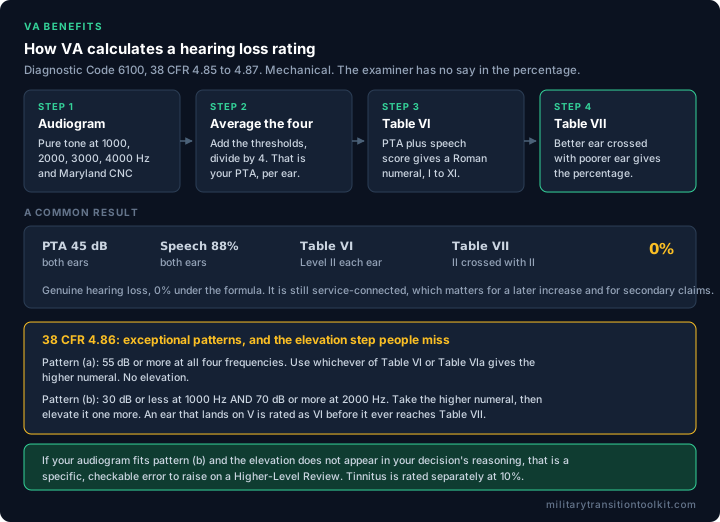
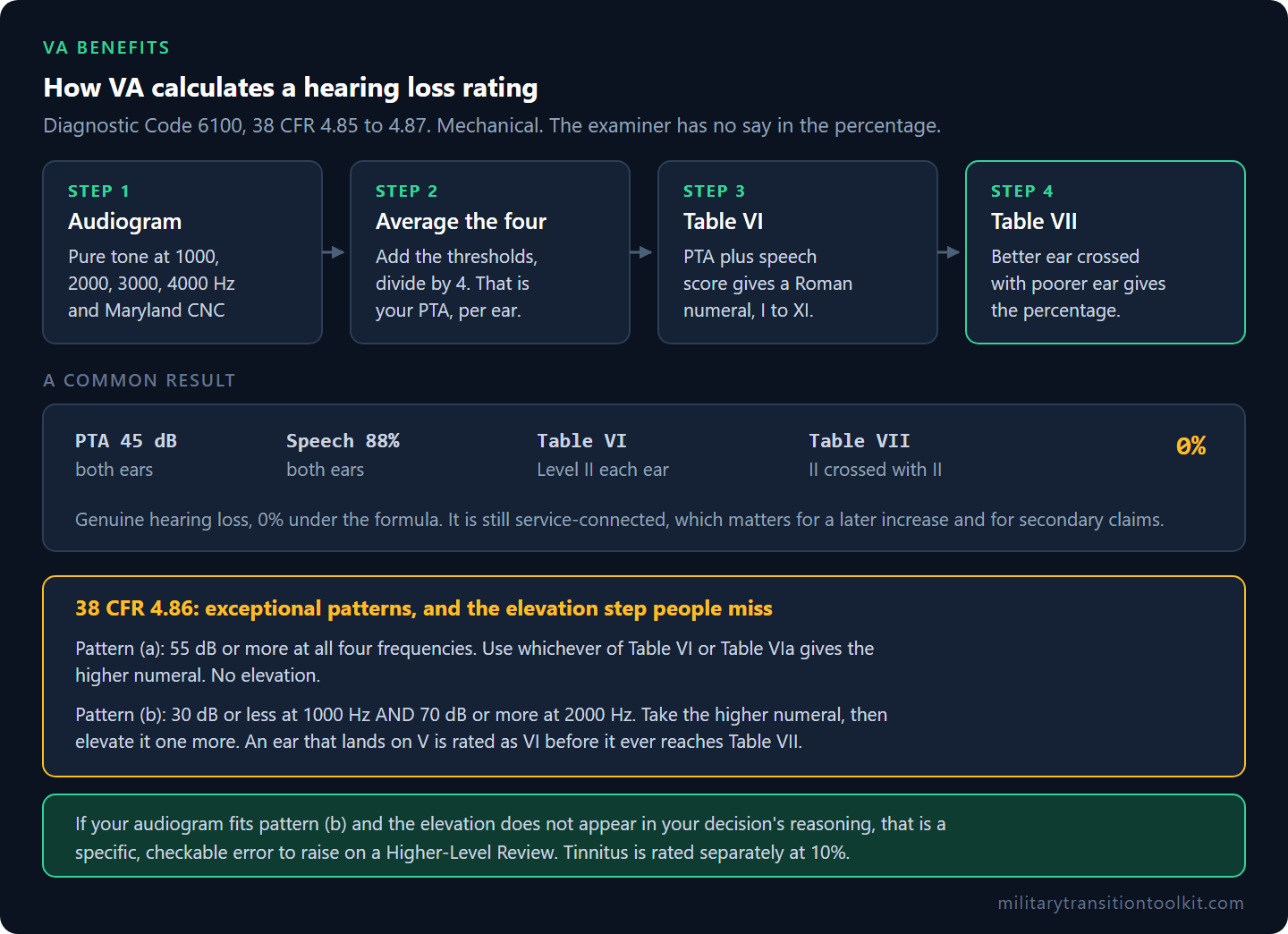
The four mechanical steps behind Diagnostic Code 6100, why genuine hearing loss so often lands at 0 percent, and the 38 CFR 4.86(b) elevation step that gets skipped.
You can use this
Put it in a brief, a TAP class, a unit newsletter, a VSO handout or your own site. No permission needed and nothing to fill out. Credit it with a link so readers can find the source and check the numbers themselves. Do not sell it on its own, and do not edit the figures and leave our name on it.
The PNG is the one to use for slides, email and anything that will not render an SVG. Grab the SVG if you need it sharp at any size.
Source: How VA calculates a hearing loss rating — Military Transition Toolkit (https://www.militarytransitiontoolkit.com/diagrams/hearing-loss-rating-calculation)
<figure>
  <img src="https://www.militarytransitiontoolkit.com/diagrams/hearing-loss-rating-calculation.png"
       alt="How VA calculates a hearing loss rating under Diagnostic Code 6100. The calculation is mechanical and the examiner has no discretion over the percentage. Step 1, the C and P audiogram measures pure tone thresholds at 1000, 2000, 3000 and 4000 hertz plus a Maryland CNC speech discrimination score, for each ear. Step 2, the four thresholds are added and divided by four to give the pure tone threshold average. Step 3, Table VI converts that average and the speech discrimination score into a Roman numeral from I to XI for each ear. Step 4, Table VII crosses the better ear against the poorer ear to produce the percentage. A common worked example: a pure tone average of 45 decibels in both ears with 88 percent speech discrimination gives Level II in each ear, which is 0 percent under Table VII. That is real hearing loss that still rates 0 percent, though it remains service-connected, which matters for future increases and secondary claims, and tinnitus is rated separately at 10 percent. Under 38 CFR 4.86, pattern a is 55 decibels or more at all four frequencies and uses whichever of Table VI or Table VIa gives the higher numeral, with no elevation. Pattern b is 30 decibels or less at 1000 hertz and 70 decibels or more at 2000 hertz, and after taking the higher numeral it is then elevated to the next higher Roman numeral, so an ear that lands on V is rated as VI before it ever reaches Table VII."
       width="720" height="522">
  <figcaption>
    How VA calculates a hearing loss rating. Source:
    <a href="https://www.militarytransitiontoolkit.com/diagrams/hearing-loss-rating-calculation">Military Transition Toolkit</a>
  </figcaption>
</figure>
Where this comes from
This diagram is drawn from VA disability ratings for hearing loss, which cites the regulations and rate tables behind every figure shown here. If a rate changes, the guide and the diagram are updated together.