VA Disability Rating for Hearing Loss: Getting Your Claim Approved
How to get VA disability rating for hearing loss. Rating criteria from 0% to 100%, how the VA calculates ratings, evidence needed, and C&P exam tips.
Bottom Line Up Front
Hearing loss is rated under Diagnostic Code 6100 with ratings from 0% to 100%, but most veterans receive 0-10% even with significant hearing loss. The VA uses a complex formula based on speech discrimination scores and pure tone threshold averages from audiometric testing. Unlike most conditions, the rating is determined by a rigid mathematical calculation, not examiner judgment. Service connection is usually easy to establish (military noise exposure), but getting a compensable rating requires objective hearing loss meeting specific criteria. Always claim tinnitus alongside hearing loss, it's a separate 10% rating. Claims typically take 3-6 months.
What Is Hearing Loss and How Does Military Service Cause It?
Hearing loss is reduced ability to hear sounds. It can be:
- Sensorineural: Damage to inner ear (cochlea) or auditory nerve, most common in veterans
- Conductive: Problems with outer or middle ear
- Mixed: Combination of both
Military causes of hearing loss:
- Weapons fire: Rifles, machine guns, artillery, grenades (extremely loud, repeated exposure)
- Explosions: IEDs, mortars, rockets, breaching charges
- Aircraft noise: Flight lines, helicopter operations, jet engines
- Vehicle noise: Tanks, APCs, ship engine rooms, HMMWVs
- Industrial equipment: Generators, machinery, power tools
- Blast exposure: Concussive injuries damaging hearing
- Occupational noise: Communications equipment, sonar (Navy)
Why hearing loss claims are usually granted for service connection: The VA recognizes that virtually all military service involves noise exposure exceeding safe limits. Your MOS alone often establishes noise exposure. The challenge isn't proving service connection, it's getting a compensable rating.
VA Rating Criteria for Hearing Loss
Hearing loss is rated under 38 CFR § 4.85-4.87, Diagnostic Code 6100. The rating is calculated mechanically using tables, there's no examiner discretion on rating percentage.
The Rating Process
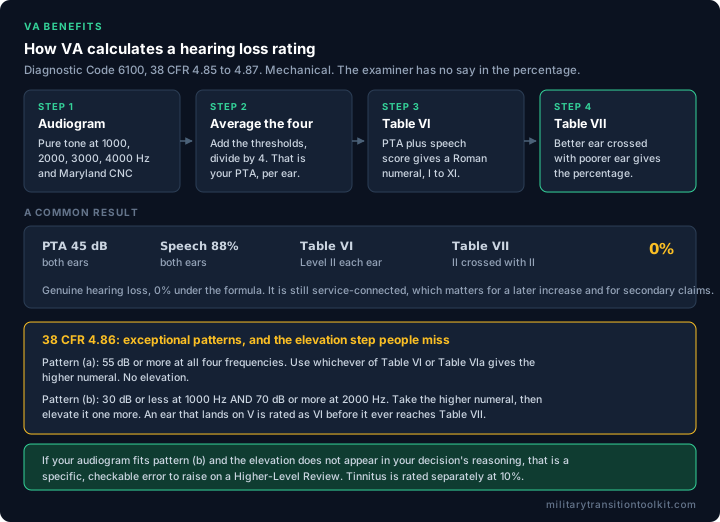
Step 1: Audiometric Testing The C&P audiogram measures:
- Pure Tone Thresholds at 1000, 2000, 3000, and 4000 Hz for each ear
- Speech Discrimination Score (Maryland CNC word list) for each ear
Step 2: Calculate Pure Tone Threshold Average (PTA) Add the thresholds at 1000, 2000, 3000, and 4000 Hz, then divide by 4.
Example:
- 1000 Hz: 25 dB
- 2000 Hz: 35 dB
- 3000 Hz: 45 dB
- 4000 Hz: 55 dB
- PTA = (25+35+45+55)/4 = 40 dB
Step 3: Determine Numeric Designation Using Table VI Using your PTA and speech discrimination score, find your Roman numeral designation (I through XI) for each ear.
Step 4: Find Rating Using Table VII Cross-reference the designations for both ears to find your rating percentage.
Understanding the Tables
Table VI: Numeric Designation Based on PTA and Speech Discrimination
| PTA (dB) | % Speech Discrimination |
|---|---|
| 92-100% | |
| 0-41 | I |
| 42-49 | I |
| 50-57 | II |
| 58-65 | II |
| 66-73 | III |
| 74-81 | III |
| 82-89 | IV |
| 90-97 | IV |
| 98+ | V |
Table VII: Percentage Evaluation (Simplified)
| Better Ear | Poorer Ear Roman Numeral |
|---|---|
| I | |
| I | 0 |
| II | |
| III | |
| IV | |
| V | |
| VI | |
| VII | |
| VIII | |
| IX | |
| X | |
| XI |
Table VIa: Exceptional Patterns of Hearing Impairment
Under 38 CFR § 4.86, if you have an exceptional pattern, you may use Table VIa (which doesn't require speech discrimination, just PTA):
Exceptional Pattern (a): Pure tone threshold is 55 dB or more at each of the four frequencies (1000, 2000, 3000, 4000 Hz)
Exceptional Pattern (b): Pure tone threshold is 30 dB or less at 1000 Hz and 70 dB or more at 2000 Hz
When exceptional patterns apply, VA uses whichever of Table VI or Table VIa produces the higher Roman numeral, and each ear is evaluated separately.
Pattern (b) has an extra step that is easy to miss and is worth checking on your rating decision. Under 38 CFR § 4.86(b), once the higher numeral has been picked from the two tables, that numeral "will then be elevated to the next higher Roman numeral." Pattern (a) has no such elevation. So a pattern (b) ear that lands on numeral V is rated as VI before it ever reaches Table VII.
That single step can move the final percentage. If your audiogram shows 30 dB or less at 1000 Hz and 70 dB or more at 2000 Hz and the elevation does not appear in your decision's reasoning, that is a specific, checkable error to raise on a Higher-Level Review.
Why Most Veterans Get 0%
Here's the uncomfortable truth: The VA rating system is very strict. You can have significant hearing loss that affects your daily life and still receive 0%.
Example:
- Veteran has PTA of 45 dB in both ears
- Speech discrimination of 88% in both ears
- Table VI: Both ears = Level II
- Table VII: Level II + Level II = 0%
This veteran clearly has hearing loss and struggles in conversations, but the VA formula results in 0%.
Why this matters:
- Even 0% is service-connected (important for future increases and secondary claims)
- Claim tinnitus separately, that's 10% regardless of hearing loss rating
- If hearing worsens, you can file for increase
Evidence You Need to Win Your Claim
Service Connection Evidence
Noise exposure documentation:
- MOS/rating that involves noise exposure
- DD-214 showing combat deployments
- Audiograms from service (especially showing hearing decline)
- Hearing conservation program records
- Personal statement about noise exposure
Most MOSs establish noise exposure: Infantry, artillery, armor, aviation, military police, mechanics, engineers, naval personnel (especially below decks), and most others.
Current Diagnosis Evidence
-
VA C&P audiogram (required for rating)
- Must use Maryland CNC word list for speech discrimination
- Must test at 1000, 2000, 3000, 4000 Hz
- Must be conducted by licensed audiologist
-
Private audiogram (optional, helpful)
- Can establish hearing loss exists before C&P
- Must meet VA requirements to be used for rating
Important Note on Service Connection
For VA purposes, hearing loss is a "disability" only when thresholds meet criteria in 38 CFR § 3.385:
- 40 dB or greater at any one frequency (500-4000 Hz), OR
- Three frequencies at 26 dB or greater, OR
- Speech recognition less than 94% using Maryland CNC
You can be service-connected for hearing loss that doesn't meet disability criteria at separation if it meets criteria now and is connected to service noise exposure.
C&P Exam: What to Expect
The hearing loss C&P exam includes:
Audiometric testing:
- You'll sit in a soundproof booth
- Wear headphones
- Press a button when you hear tones (pure tone testing)
- Repeat words you hear (speech discrimination)
What the examiner will ask:
- "What type of noise were you exposed to in service?"
- "When did you notice hearing problems?"
- "Do you have difficulty hearing conversations?"
- "Do you use hearing aids?"
Tips for accurate results:
- Don't over-try or under-try: Respond naturally to what you hear
- Rest before the exam: Fatigue can affect results
- Avoid loud noise 24 hours before: Temporary threshold shift can skew results
- Remove hearing aids before testing: Test your unaided hearing
- Be honest about difficulty understanding words: This affects speech discrimination
What to tell them:
- Describe all noise exposure: Every weapon, vehicle, aircraft, explosion
- Explain functional impact: "I can't hear my wife when she's not facing me"
- Mention hearing aid use: If prescribed, this supports claim
- Don't exaggerate: The audiogram is objective, they'll see if you're not responding accurately
Common mistakes:
- Trying to "fail" the test: Audiologists can detect inconsistent responses, this hurts credibility
- Testing while fatigued: Schedule exam when you're alert
- Not reporting all noise exposure: Be thorough
- Forgetting to claim tinnitus: Always claim tinnitus with hearing loss
Free tool for this exact situation
Track your conditions, C&P prep, and nexus letters in one place.
Secondary Conditions to Claim With Hearing Loss
Always consider claiming related conditions (our VA condition rating guides cover each of these in depth):
-
Tinnitus - DC 6260
- ALWAYS claim this with hearing loss
- Same noise exposure causes both
- Automatic 10% if recurrent
- Claimed separately from hearing loss
-
Meniere's Disease - DC 6205
- Causes hearing loss, vertigo, tinnitus
- Rated 30-100%
- If you have vertigo episodes, consider this
-
Depression/Anxiety - DC 9434, 9400
- Social isolation from hearing difficulty
- Communication frustration
- Sleep disruption from tinnitus. This is often the stronger nexus and it gets left out. Tinnitus is usually worst in a quiet room, which is where people try to sleep, and chronic sleep loss is a well-documented driver of depression and anxiety. If that is your situation, describe it in those terms rather than as general frustration, and make sure your provider records the sleep problem and ties it to the tinnitus.
- One caution: chronic insomnia does not carry its own diagnostic code. It is evaluated under the General Rating Formula for Mental Disorders, the same formula used for depression and anxiety. Claiming insomnia and depression as two separate ratings for the same symptoms runs into the anti-pyramiding rule at 38 CFR § 4.14, which bars rating the same disability under several diagnoses. One mental health rating that accurately reflects the whole picture, sleep included, is worth more than two that conflict.
-
Vestibular Disorders - DC 6204
- Inner ear damage affects balance
- Dizziness, vertigo
-
TBI - DC 8045
- If blast exposure caused both TBI and hearing loss
Common Reasons Claims Get Denied (And How to Avoid Them)
1. "No current hearing loss disability"
Why it happens: Audiogram doesn't meet 38 CFR § 3.385 criteria How to avoid:
- You need at least one frequency at 40+ dB, three or more frequencies at 26+ dB, or speech discrimination under 94%
- If borderline, get tested again, results can vary slightly
2. "No nexus to service"
Why it happens: Examiner attributes hearing loss to aging or other causes How to avoid:
- Document military noise exposure thoroughly
- Show hearing was normal at entry, declined during/after service
- Get buddy statements about shared noise exposure
3. "Rating is 0%"
Why it happens: Formula calculation results in 0% How to understand:
- This is still service-connected, important for future
- Claim tinnitus separately (10%)
- File for increase if hearing worsens
4. "Pre-existing hearing loss"
Why it happens: Entry audiogram showed some hearing loss How to avoid:
- Argue aggravation during service
- Show worsening between entry and exit audiograms
- Document noise exposure that worsened condition
How to Write a Strong Personal Statement
Personal Statement for Hearing Loss Claim
I, [Full Name], am submitting this statement in support of my claim for service connection for bilateral hearing loss.
Military Service and Noise Exposure: I served in the [Branch] from [dates] with MOS/Rating [XXX]. During my service, I was regularly exposed to hazardous noise levels, including:
Weapons:
- [List all weapons you fired or were exposed to: M16, M4, M240, M2, artillery pieces, mortars, grenades, etc.]
- Approximate rounds fired: [Estimate if possible]
- Frequency of weapons training/qualification: [Monthly, quarterly, etc.]
Vehicles:
- [List vehicles: tanks, HMMWVs, helicopters, jets, ships, etc.]
- Time spent operating or around these: [Daily, during deployments, etc.]
Other Noise:
- [Explosions, generators, machinery, flight lines, etc.]
- [Specific incidents: IED explosions, firefights, etc.]
Hearing Protection: [Describe hearing protection use, was it always available? Always used? Adequate?] During [combat/operations/training], hearing protection [was not always practical/was not provided/was inadequate].
When I Noticed Hearing Problems: I first noticed hearing difficulty [during service/shortly after separation/gradually over time]. Symptoms included:
- Difficulty hearing conversations, especially in noisy environments
- Asking people to repeat themselves
- Turning up TV/radio volume
- Difficulty hearing on the phone
Current Symptoms: Today, I experience the following hearing difficulties:
- [Describe specific situations where hearing is difficult]
- I [do/do not] use hearing aids
- I [have/have not] been told I need hearing aids
Impact on Daily Life: My hearing loss affects my daily life in the following ways:
- Communication: [Difficulty with spouse, at work, social situations]
- Safety: [Missing alarms, warnings, environmental sounds]
- Work: [Job limitations due to hearing]
- Social: [Withdrawal, embarrassment, frustration]
I also experience tinnitus (ringing in the ears) which I am claiming separately.
I certify that the above statements are true and correct to the best of my knowledge.
[Signature] [Date]
Buddy Statement Tips for Hearing Loss
For fellow service members:
- Describe noise exposure you shared
- Note any complaints about hearing
- Confirm weapons, vehicles, events you were exposed to together
For family members:
- Describe hearing difficulties you've observed
- Specific situations (turning up TV, asking to repeat)
- Compare to hearing before service if applicable
Example: "I am the spouse of [Veteran's Name]. Since they returned from service, I have noticed significant hearing difficulty. They frequently ask me to repeat myself and cannot hear me from another room. The TV volume is always set higher than comfortable for me. They often miss what people say in restaurants or group conversations. They complain about ringing in their ears regularly. These difficulties were not present before their military service / have worsened significantly since their service."
Appeal Strategies If Denied
Higher-Level Review (HLR)
Best for: If audiogram results were improperly applied to tables When to use: If you believe the math was done wrong or exceptional pattern wasn't applied
Supplemental Claim
Best for: Getting a new audiogram What to submit:
- New audiology examination
- Statement addressing prior denial reasons
- Additional evidence of noise exposure
Board of Veterans Appeals
Best for: Complex nexus disputes When to use: If service connection is denied despite obvious noise exposure
Hearing loss appeal tips:
- If rated 0%, file for increase when hearing worsens
- Get private audiogram to compare to VA results
- Challenge if exceptional pattern criteria met but not applied
- Don't forget tinnitus is a separate claim
Frequently Asked Questions
Why did I get 0% when I clearly have hearing loss?
The VA rating formula is very strict. Significant hearing loss can still result in 0%. The good news is 0% is still service-connected, which means:
- Free hearing aids from VA
- Future increases if hearing worsens
- Secondary conditions can be claimed
Should I claim hearing loss even if I expect 0%?
Yes. Service connection matters for:
- VA healthcare and hearing aids
- Future increases when hearing worsens
- Secondary conditions
- Combined rating calculations
Can I appeal a 0% rating?
You can, but the rating is based on objective audiogram results and a mathematical formula. Unless the exam was flawed or exceptional pattern criteria apply, the rating likely won't change. Better strategy: claim tinnitus (10%) and file for increase when hearing worsens.
Does wearing hearing aids affect my rating?
No. The VA tests your unaided hearing. However, hearing aid use documents that you have significant hearing loss, which supports your claim.
What if I have hearing loss in one ear only?
Unilateral (one ear) hearing loss is rated using Level I for the good ear. This often results in 0% unless the bad ear is severely affected.
How do I prove noise exposure?
Your MOS usually establishes noise exposure. Document specific weapons, vehicles, and situations in your statement. Buddy statements help.
Should I get a private audiogram before the C&P exam?
Optional but can be helpful. Make sure it meets VA requirements (Maryland CNC word list, frequencies tested) if you want it considered for rating.
Resources
VA Forms and Documents:
- VA public DBQ directory — note the Hearing Loss and Tinnitus DBQ (21-0960N-6) is not on it. VA restricts that one to authorised examiners, so you cannot download it and take it to your own audiologist the way you can with some other conditions.
- VA Claim Application (VA Form 21-526EZ)
VA Rating Information:
- 38 CFR § 4.85 - Evaluation of Hearing Impairment
- 38 CFR § 4.86 - Exceptional Patterns of Hearing Impairment
- 38 CFR § 3.385 - Disability Due to Impaired Hearing
Additional Support:
This guide is for informational purposes only and does not constitute legal advice. Every claim is unique, and you should consult with an accredited VA claims agent or attorney for personalized guidance.
Sources: VA Disability Compensation, 38 CFR Part 4, Veterans Benefits Administration
Military Transition Toolkit — free
Free VA tools in your transition toolkit
VA Combined Rating Calculator
Calculate your combined rating the same way VA does
VA Claims Tracker
Track your claim, conditions, and C&P prep in one place
All tools are 100% free. Create a free account to access account tools.
Related articles
VA Disability: Unemployability (TDIU) vs 100% Rating - Which Should You Pursue?
Compare TDIU vs 100% rating. Understand differences, approval rates, monthly payments, and which path best for your situation.
va-disabilityVA Disability Rating for Vertigo: Complete Guide to Getting Your Claim Approved
How to get VA disability rating for vertigo and vestibular disorders. Rating criteria from 10% to 100%, evidence needed, and C&P exam tips.
va-disabilityVA Disability Rating for Sinusitis and Rhinitis: Complete Guide to Getting Your Claim Approved
How to get VA disability rating for sinusitis and allergic rhinitis. Rating criteria from 0% to 50%, evidence needed, and C&P exam tips.