VR&E Self-Employment: VA Funding to Start a Business (2026)
VR&E can fund your startup, equipment, training, and capital, if you qualify. Who's eligible, what VA pays for, and the TDIU trap to avoid.
VR&E's Self-Employment track is the most misunderstood program VA runs for service-connected veterans. It's not "VA pays for your startup if you want to be your own boss", the VRC still has to determine that self-employment is a suitable, feasible vocational goal for you. But it is also not reserved for the severely disabled: under the current regulation, self-employment can be approved for any VR&E participant when VA finds it a suitable goal, with the most extensive funding (equipment, inventory, and more) reserved for veterans with the most severe service-connected disabilities. Expect mandatory SBA coordination and an approval ceiling that escalates to VA Central Office above $25K.
This guide covers the actual mechanics, eligibility, what VA funds, the business-plan approval process, common denied categories, the TDIU interaction (real risk), and the tax treatment.
Bottom line up front
- Self-employment can be approved for any VR&E participant when VA determines it is a suitable vocational goal (38 CFR § 21.257(a)). The most extensive funding is reserved for veterans whose service-connected disability is "so severe" that self-employment is the only reasonably feasible goal (§ 21.257(b)), who qualify for enhanced services under § 21.257(e).
- It's NOT automatic, the VRC must still determine self-employment is a suitable and feasible vocational goal for you
- What VA pays for: vocational training, business management instruction, license/permit fees, tools, supplies, plus broader services for the most severely disabled
- Approval levels: Plans <$25K approved by local VR&E Officer; $25K+ require VA Central Office approval
- SBA Veterans Business Outreach Center (VBOC) coordination is regulatorily required (§ 21.257(f)(5))
- TDIU veterans: real risk that VR&E participation undermines TDIU. Talk to a VSO/attorney first
Who actually qualifies
Statutory authority: 38 USC Chapter 31. Track-specific rule: 38 CFR § 21.257.
What the regulation actually says:
§ 21.257(a): "A program of vocational rehabilitation benefits and services may include self-employment for an individual if VA determines that such an objective is a suitable vocational goal."
So self-employment is not limited to the severely disabled, that is a common misreading of the pre-2010 rule. What it is NOT is automatic: the VRC must determine self-employment is a suitable vocational goal for you, given your abilities, aptitudes, interests, and business plan. A separate, narrower standard, § 21.257(b), defines veterans whose service-connected disability is "so severe" that self-employment is the only reasonably feasible goal; that group qualifies for the more extensive services in § 21.257(e), but it is not the eligibility gate for the track itself.
In practice, a VRC is more likely to approve self-employment when:
- The veteran is service-connected with an employment handicap (VR&E's underlying eligibility)
- Self-employment is a realistic fit for the veteran's abilities and situation
- The business plan is sound and the veteran can run it
The Self-Employment track (Track 3 of VR&E's five tracks) suits veterans whose service-connected disabilities make traditional employment difficult, as well as veterans with a sound business plan and the ability to run it.
What VA actually pays for
Per 38 CFR § 21.257(d), Self-Employment participants generally receive:
- Vocational training (industry-specific skills)
- Incidental business management instruction (basic ops, accounting, marketing fundamentals)
- License fees and permits (occupational licenses, business permits, certifications)
- Necessary tools and supplies for the trade/profession
- General services under § 21.252 (counseling, evaluation, plan development)
For veterans with the most severe service-connected disabilities, additional (extensive) services are available under § 21.257(e), broader supplies, equipment, inventory, and "other assistance" needed for the rehabilitation plan.
Critical mechanic: VR&E does NOT take an equity stake. Funding is structured as a non-equity grant, the veteran retains 100% of business equity. This matters for SDVOSB certification (more below).
The $25K approval threshold (38 CFR § 21.258)
| Plan Total | Approval Authority |
|---|---|
| Under $25,000 | Local VR&E Officer at your regional office |
| $25,000 or more | Executive Director of VR&E Service (VA Central Office) |
The $25K line is an approval-authority threshold, not a maximum. Larger plans CAN be funded, they just need headquarters sign-off. There's no published statutory ceiling.
Practical reality: plans under $25K move significantly faster (30-60 days). Plans over $25K can take 4-6 months for Central Office review.
The mandatory SBA VBOC coordination (38 CFR § 21.257(f)(5))
This is the procedural step most veterans miss until their VRC asks for it.
The Veterans Business Outreach Center (VBOC) program, roughly 31 SBA-funded centers nationwide, is the de-facto SBA partner for VR&E Self-Employment plans. Per § 21.257(f)(5), the VRC's feasibility analysis MUST include "evidence of coordination with the Small Business Administration."
What VBOCs do for VR&E applicants:
- Business plan development/review
- 1:1 counseling
- Workshops on financial statements, marketing, ops
- Specialized training (manufacturing, exporting, franchising, digital marketing)
- Co-author or stress-test the business plan the VRC reviews
VBOCs also run Boots to Business (B2B) at military installations and B2B Reboot off-base, both are TAP-aligned entrepreneurship courses.
Move: Find your VBOC before your initial VRC meeting. Walking into the VRC with a VBOC counselor's signature on your draft business plan dramatically accelerates approval.
The business plan approval process
Per VA.gov + M28R Ch. 9:
Step 1: Apply for VR&E (VA Form 28-1900 / VA.gov online) Step 2: Orientation at VARO Step 3: VRC entitlement determination + assignment to Self-Employment track if VA determines self-employment is a suitable vocational goal (§ 21.257(a)) Step 4: Business concept analysis with VRC (typically 30-60 days into case) Step 5: Business plan developed (veteran-led, often with VBOC assistance) Step 6: Comprehensive feasibility review by VRC, must include per § 21.257(f):
- Economic viability assessment
- Cost analysis specifying dollar amounts of VA assistance
- Market analysis of proposed product/service
- Review of non-VA financing availability
- Evidence of SBA coordination
- Business site location and costs
- Training plan for successful operation
Step 7: Approval at appropriate level (<$25K local, $25K+ Central Office) Step 8: Plan execution + monitoring
Typical end-to-end timeline: 90-180 days for small plans; 6-12 months for large plans.
Subsistence allowance during the training phase
Self-Employment track veterans receive the same FY2026 subsistence rates as other tracks during the training/plan-execution phase:
| Status | No Dep | 1 Dep | 2 Dep |
|---|---|---|---|
| Full-time institutional | $812.84 | $1,008.24 | $1,188.15 |
Once the business is operating, subsistence ends and earned income takes over. Some Track 3 veterans extend institutional training (business management courses, industry-specific cert programs) to extend subsistence eligibility.
See: VR&E Subsistence Allowance Explained.
Categories that get denied
VA's regulation doesn't list categorical bans, but VR&E policy and broader VR practice consistently deny:
| Business Category | Status |
|---|---|
| Speculative ventures (gambling, day trading, crypto trading) | Denied |
| Passive ventures (rental property holdings, limited partnerships) | Denied |
| Multi-level marketing / pyramid / network-recruiting | Denied |
| Illegal goods/services (cannabis in many states) | Denied |
| Non-profits / 501(c)(3)s | Generally denied (not "self-employment income") |
| Unlicensed hobby businesses | Denied |
| Franchises | Frequently denied or heavily scrutinized |
| Businesses paying below minimum wage | Denied |
Approved categories typically share: licensable trade/profession, demonstrable market, veteran has the skills (or gets training), viable financials, not dependent on speculative upside.
Common approvals: trades (HVAC, plumbing, electrical, welding), licensed professional services (accounting, IT consulting, photography), service businesses (cleaning, lawn care, repair), e-commerce with real product.
SDVOSB certification, does VR&E funding affect "unconditional ownership"?
Short answer: No.
Per 13 CFR § 128.202, unconditional ownership is about ownership not being subject to conditions, voting trusts, encumbrances, or agreements that shift benefits to non-veterans. VR&E pays for tools, supplies, training, and licensing, not equity. The veteran retains 100% of their own equity; VA does not take an ownership stake or a security interest.
VR&E funding is best characterized as a non-equity grant for the disabled-veteran owner, not "outside investment."
Caveat, the control test (13 CFR § 128.203): the service-disabled veteran must control day-to-day management and hold the highest officer position. Track 3 doesn't disturb this. (Permanent/severely disabled exception: spouse or permanent caregiver may control.)
Free tool for this exact situation
GI Bill, state tuition waivers, and VR&E — compared by state.
SDVOSB certification is now SBA's VetCert (transferred from VA CVE under the FY2021 NDAA, effective 1/1/2023). Apply at veterans.certify.sba.gov.
Subcontracting reminder: Per FY2024 NDAA, all veteran firms claiming SDVOSB status for federal subcontracting/goaling had to be SBA-certified by 12/22/2024.
The TDIU landmine (real risk)
If you're rated TDIU (Total Disability based on Individual Unemployability), VR&E Self-Employment is genuinely complicated.
The legal frame:
- 38 CFR § 4.16: "Marginal employment" = earned annual income ≤ Census Bureau poverty threshold for one person (~$15,650 in 2025)
- Income above the poverty threshold can still be marginal "on a facts-found basis" if employment is in a "protected environment" (38 CFR § 4.16(a)), explicitly including "a family business or sheltered workshop"
- Marginal employment ≠ substantially gainful employment, so TDIU continues
The VR&E-TDIU tension:
- A formal VRC finding that the veteran is "employable" can directly undermine TDIU
- M21-1 instructs raters to consider VR&E records when adjudicating TDIU continuation
- Successfully completing VR&E (any track) can trigger TDIU re-evaluation
Practical advice: If you're on TDIU, talk to an accredited VSO or attorney before entering VR&E. The income-cap math (poverty threshold for one) is restrictive enough that most viable businesses exceed it within 12-18 months. There are paths through this, sheltered employment classifications, family-business protections, but they're fact-specific and high-audit-risk.
Tax treatment
Statutory foundation, 38 USC § 5301:
"Payments of benefits due or to become due under any law administered by the Secretary [VA] shall not be assignable... Such payments shall be exempt from taxation."
Practical application:
| Item | Tax Treatment |
|---|---|
| VR&E subsistence allowance | Tax-free under 38 USC § 5301 |
| VR&E-paid tuition, fees, books, supplies, tools | Tax-free (in-kind VA benefit) |
| Direct grants for self-employment startup (tools, equipment, working-capital purchases by VA) | Tax-free as VA benefits |
| Business income earned from the resulting business | Fully taxable as ordinary self-employment income (Schedule C, SE tax) |
Common confusion: the VA's tax exemption covers the grant, not the revenue the business produces. If VR&E funds your $40K welding shop startup, that $40K isn't taxable income. But the $80K/year your shop earns is fully taxable.
If VA payments somehow exceed actual qualified expenses (rare in Self-Employment context but possible in education-heavy plans), the excess can become taxable, analogous to scholarship overage rules.
Outcomes data, what's published
Honest answer: not much. No published "Self-Employment success rate" exists in current VBA reporting.
Key reports:
- VA OIG Audit 11-00317-37 (2012): OIG concluded "a meaningful statistical projection wasn't possible because VR&E couldn't reliably identify all self-employment participants in its data", itself a damning finding about Track 3 record-keeping
- CRS Report RL34627 (May 2021, FY2019 data): ~96% of VR&E participants are in the Long-Term Services track. Self-Employment is a single-digit-percentage minority of caseload
- GAO-09-34: flagged broader VR&E performance-reporting weaknesses
Treat any third-party "X% Self-Employment success rate" stat with skepticism.
Common mistakes
1. Assuming approval is automatic because you have a service-connected rating and want to start a business. Self-employment still has to be found a suitable vocational goal by your VRC (§ 21.257(a)); a rating plus a business idea is not enough.
2. Skipping VBOC coordination. It's regulatorily required, not optional. Get it before your VRC meeting.
3. Pitching a category VRCs always deny. MLM, day trading, passive real estate, franchises, VRCs see these every week and reject them. Pick a category with clear journeyman or professional-service framing.
4. Triggering TDIU re-evaluation without realizing it. If you're on TDIU, talk to an accredited rep first.
5. Confusing VR&E funding with equity investment. It's a grant, not capital. SDVOSB ownership tests are unaffected.
6. Forgetting business income is taxable. Tools and grants tax-free; revenue your business produces is fully taxable Schedule C income.
The application path
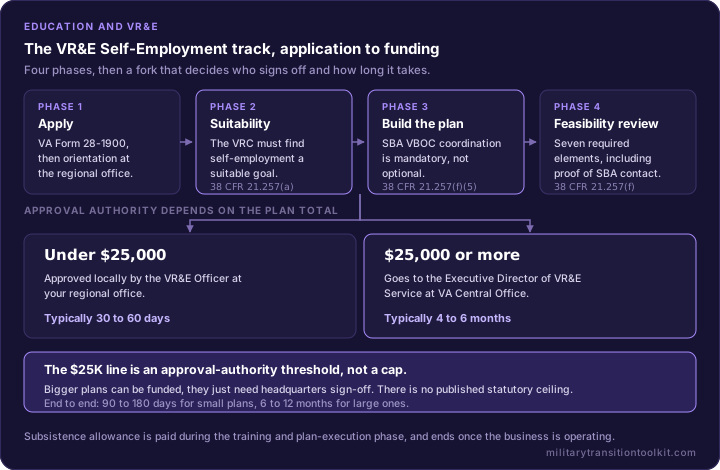
- File VAF 28-1900 (or apply online at VA.gov VR&E), see How to Apply for VR&E
- Initial counseling, discuss Self-Employment as a goal
- Establish suitability, VRC must find self-employment a suitable vocational goal (§ 21.257(a))
- Coordinate with VBOC, find yours via SBA directory
- Develop business plan with VBOC + your industry experience
- Comprehensive feasibility review by VRC per § 21.257(f)
- Approval (local <$25K, Central Office $25K+)
- Execute plan with VR&E funding + ongoing VRC support
Bottom line
VR&E Self-Employment is a real, funded path, but approval is not automatic. The suitability determination (§ 21.257(a)), the SBA VBOC coordination requirement, and the TDIU interaction are the three things that filter out most applicants before they realize.
For veterans with the most severe disabilities, the enhanced services under § 21.257(e) make this one of the most generous benefits VA runs. For other participants, self-employment is still on the table when the VRC finds it a suitable goal, and the SBA Boots to Business + Veterans Business Outreach Center programs are available to support entrepreneurship either way.
Frequently asked questions
Can VR&E really pay to start a business?
Yes, through its Self-Employment track, but not automatically. Your Vocational Rehabilitation Counselor first has to determine that self-employment is a suitable and feasible vocational goal for you. If they do, VA can fund the plan.
What does the VR&E self-employment track pay for?
It can cover training and, for veterans with the most severe service-connected disabilities, business equipment, inventory, supplies, and more. The extent of the funding scales with disability severity and what your counselor approves.
What is the $25,000 approval threshold?
Under 38 CFR 21.258, a self-employment plan costing less than $25,000 can be approved by the VR&E Officer with jurisdiction, while a plan costing $25,000 or more has to be approved higher up, by the Executive Director of VR&E Service.
Do I have to work with the SBA?
Yes. Under 38 CFR 21.257(f)(5), developing a self-employment plan includes coordination with the Small Business Administration (SBA). In practice, that help often comes through an SBA Veterans Business Outreach Center (VBOC), which helps you develop and vet your business plan.
Does VR&E self-employment funding affect my TDIU?
It can, and this is the biggest trap. If you receive TDIU (total disability based on individual unemployability) and your business income shows you can maintain substantially gainful employment, that can put your TDIU at risk. Read the TDIU section above and get advice before you proceed.
Is VR&E business funding taxable?
VA benefits are generally exempt from taxation under 38 USC 5301. See the tax treatment section above, and confirm your specific situation with a tax professional.
Related:
- How to Apply for VR&E: VAF 28-1900 Step-by-Step
- VR&E Subsistence Allowance Explained
- VR&E vs GI Bill: Which to Use
- VR&E for Trade Schools: Welding, HVAC, Electrician, CDL
Sources:
Military Transition Toolkit — free
Make the most of your education benefits
State Benefits Comparison
In-state tuition waivers and education benefits by state
Career Planner
Find careers worth investing your GI Bill in
All tools are 100% free. Create a free account to access account tools.
Related articles
What Is VR&E? Veterans Readiness and Employment (Chapter 31), Explained
Never heard of VR&E? Veterans Readiness and Employment (VA Chapter 31) can pay full tuition, a monthly living allowance, tools, and career help for service-connected veterans, and it doesn't touch your GI Bill. Here's what it is and how to know if you qualify.
Education & BenefitsVET TEC 2.0 (2026): Eligibility, Benefits, and How It Uses Your GI Bill
VET TEC 2.0 pays for veteran tech training in coding, data, and IT. 2026 eligibility, what it covers, how to apply, and how it now uses your GI Bill.
Education & BenefitsVET TEC 2.0 vs VR&E vs GI Bill: The Best Veteran Benefit for a Tech Career (2026)
VET TEC 2.0, VR&E, and the Post-9/11 GI Bill compared for a coding bootcamp or tech career change. Which pays most and which protects your GI Bill.