MEB Process Explained: Military Medical Evaluation Board Guide
How the MEB/PEB process works stage by stage, your rights at each step, and how to protect your disability rating through medical separation.
An MEB (Medical Evaluation Board) is a panel of military physicians that reviews your medical records to decide one thing: whether a medical condition disqualifies you from continued military service. It does not assign a disability rating; that job belongs to the Physical Evaluation Board (PEB), which decides fitness and, if you are found unfit, your disability percentage and whether you are separated or retired. The process is governed by DoDI 1332.18.
If you've been told you may not be fit for continued military service due to a medical condition, you're entering a process called the Disability Evaluation System (DES). At the center of that system is the Medical Evaluation Board, or MEB.
This guide covers exactly what the MEB is, how the process works, and what you can do to protect your outcome.
What Is a Medical Evaluation Board?
A Medical Evaluation Board is a panel of military physicians who review your medical records and determine whether your condition meets the military's retention standards. It is not a punishment or a discharge, it is a formal medical review process.
The MEB does not decide your disability rating. It decides one thing: whether your condition disqualifies you from continued service. That determination then feeds into the Physical Evaluation Board (PEB), which determines your fitness and, if found unfit, your disability percentage.
The process is governed by DoDI 1332.18 (the DoD Instruction for Disability Evaluation) and each service branch's implementing regulations.
How the MEB Process Starts
An MEB is initiated when:
- A military physician determines your condition may not meet retention standards
- You have a condition listed in the relevant service regulation (e.g., AR 40-501 for Army) that is presumptively disqualifying
- You've been treated for an extended period without improvement sufficient for deployment
Your unit does not initiate the MEB, your medical provider does. If you believe you have a condition serious enough to warrant an MEB but no one has initiated one, you can ask your primary care manager (PCM) to refer you.
The Two Systems: IDES and LDES
There are two versions of the DES:
Integrated Disability Evaluation System (IDES), The standard system for active duty members. VA and DoD work together simultaneously, meaning your VA rating is determined during the MEB/PEB process rather than after separation. This significantly speeds up the time between separation and your first VA check.
Legacy Disability Evaluation System (LDES), Used in limited circumstances and for some Reserve/Guard members. The VA rating is determined separately and after the military process concludes.
If you're on active duty, you're almost certainly going through IDES.
Key Stages in the IDES Process
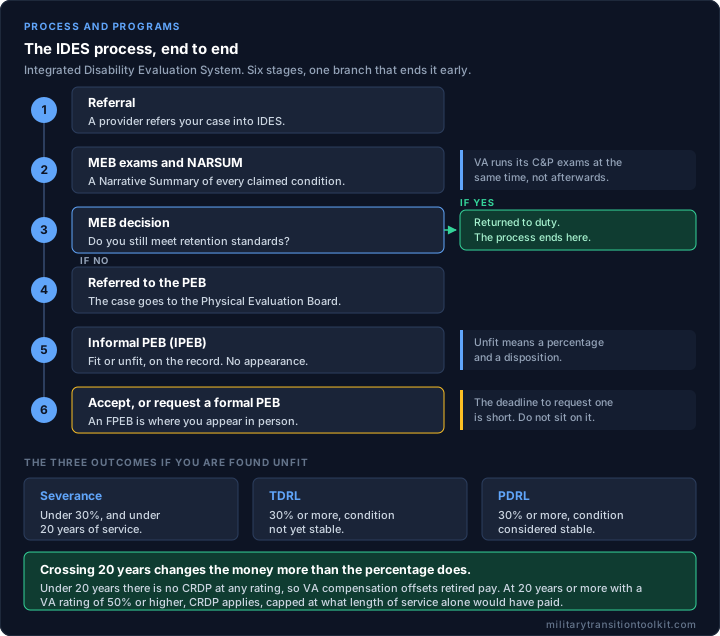
1. Referral and Case Assignment Your case is assigned to a Physical Evaluation Board Liaison Officer (PEBLO). This person is your guide through the entire process. Get their contact information immediately and stay in close communication.
2. MEB Medical Exam You'll undergo a comprehensive medical evaluation. All conditions, not just the one that triggered the MEB, should be documented here. This is critical: conditions not documented in the MEB may not be rated. Tell every examiner about every condition affecting your ability to work and function.
3. Narrative Summary (NARSUM) The military physician writes a Narrative Summary documenting your conditions and their impact. You have the right to review the NARSUM and submit a rebuttal if it's inaccurate or incomplete.
4. VA Exam (Compensation and Pension) Under IDES, the VA conducts C&P exams simultaneously with the MEB process. These exams are used to determine your VA disability rating, which will be used by the PEB.
5. MEB Decision The MEB either:
- Finds you meet retention standards (process ends, you remain on active duty)
- Refers your case to the Physical Evaluation Board (process continues)
6. Physical Evaluation Board The PEB determines:
- Whether you are fit or unfit for continued service
- If unfit: your disability percentage and disposition (separation vs. retirement)
Your Rights During the MEB/PEB
You have the right to:
- Legal counsel, A Judge Advocate (JAG) officer is available at no cost. Use one. Assigned military counsel are often very good at this specific area of law, but they carry heavy caseloads, so be direct about your timeline and get answers in writing. You may also retain a civilian attorney at your own expense, in addition to your assigned counsel rather than instead of them.
- Review all findings, You must be shown the MEB's NARSUM and the PEB's findings before they become final.
- Rebut findings, If you disagree with the NARSUM or PEB findings, you can submit a written rebuttal.
- Request a formal PEB hearing, If the informal PEB finds you unfit and you disagree with the rating, you can request a formal hearing with a personal appearance.
- Appeal to the Army Review Boards Agency, Board for Correction of Military Records, or service equivalent
Common Mistakes to Avoid
Not documenting all conditions. The MEB rating only covers conditions specifically documented. If you have sleep apnea, migraines, knee pain, or any other condition, mention it to every provider.
Accepting informal PEB findings without review. Many service members sign the informal PEB findings within days, not realizing they can request more time or a formal hearing.
Not using a JAG or VSO. Veterans Service Organizations like the DAV provide free MEB/PEB counseling and can be extraordinarily helpful in navigating the process.
Free tool for this exact situation
VA claims, resume builder, MOS translator, career planner — all free.
Underestimating how the rating affects retirement. A rating of 30% or higher results in disability retirement rather than separation with severance pay. The financial difference over a lifetime is significant.
What Comes After the PEB
If the PEB finds you unfit, your disposition will be one of the following:
- Separation with severance pay, For ratings below 30% and fewer than 20 years of service
- Permanent Disability Retirement (PDRL), For stable conditions rated 30% or higher
- Temporary Disability Retirement (TDRL), For unstable conditions rated 30% or higher; re-evaluated at least every 18 months, capped at 3 years for placements on or after 1 January 2017 (5 years before that)
See our guide on PDRL vs TDRL for a deeper breakdown.
The 20-year line changes the math more than the rating does
Two people can be found unfit at the same percentage and end up with very different money, because of years of service rather than the rating.
Fewer than 20 years. A disability retiree under Chapter 61 with fewer than 20 years is not eligible for CRDP (Concurrent Retirement and Disability Payment) at any rating. Retired pay is reduced by the amount of VA disability compensation received, the "VA waiver." CRSC (Combat-Related Special Compensation) is the only route to restoring any of it, and only for conditions that are combat-related.
20 years or more, VA rating 50% or higher. Eligible for CRDP. One important limit: the restoration is capped at what your years of service alone would have paid. Any disability retired pay above that longevity amount stays offset.
20 years or more, VA rating 40% or lower. Not eligible for CRDP.
If your projected separation date is anywhere near your 20-year mark, raise it with your PEBLO and with counsel before you accept findings. Some services have a continuation process that can hold a retirement date while it is considered.
Sources: 10 USC § 1414, DFAS: CRDP, CRS Defense Primer: Concurrent Receipt.
Navy sailors: if you were found unfit but want to stay on active duty, you may be able to request Permanent Limited Duty (PLD), in writing, within 15 calendar days of your PEB findings. If one is approved, what changes next is not obvious.
Frequently Asked Questions
What is the difference between an MEB and a PEB?
The MEB decides only whether your condition meets the military's retention standards; it does not assign a disability rating. If it finds you may not meet standards, it refers your case to the Physical Evaluation Board (PEB), which decides whether you are fit or unfit and, if unfit, sets your disability percentage and whether you are separated or retired.
Who starts the MEB process?
Your medical provider initiates an MEB, not your unit, when a physician determines your condition may not meet retention standards. If you believe you have a qualifying condition and no board has been started, you can ask your primary care manager (PCM) to refer you.
Does a 30% rating change my medical separation?
Yes. A disability rating of 30% or higher results in disability retirement rather than separation with severance pay, and the lifetime financial difference is significant.
Can I appeal the MEB or PEB findings?
Yes. You can submit a written rebuttal to the NARSUM or PEB findings, request a formal PEB hearing with a personal appearance if the informal PEB finds you unfit, and appeal further to your service's Board for Correction of Military Records. A Judge Advocate (JAG) officer is available at no cost to help.
What is the most common mistake during an MEB?
Failing to document every condition. The board only rates conditions that are specifically documented, so tell every examiner about all conditions affecting your ability to work and function, not just the one that triggered the MEB.
Track Your MEB in MTT
The MEB/PEB Tracker in Military Transition Toolkit lets you log your case status, track document deadlines, and organize the paperwork the MEB process generates. It's free and no one sees your data but you.
Sources: DoDI 1332.18 (Disability Evaluation System), 10 U.S.C. § 1201 (disability retirement/separation, Ch. 61), 10 U.S.C. § 1210 (TDRL re-exam and 3-year limit), VA disability compensation. Rules and timelines can change; confirm against the official source before acting. This is general information, not legal advice.
Estimate your rating: Use the free VA rating estimator to see where your conditions may land before you file.
Military Transition Toolkit — free
Track your MEB and VA claim together
VA Claims Tracker
Track your conditions, C&P prep, and IDES milestones in one place
VA Combined Rating Calculator
Model your VA rating before your PEB decision
All tools are 100% free. Create a free account to access account tools.
Related articles
Your PLD Was Approved: What Happens Next (2026)
What changes after a Permanent Limited Duty approval: your separation date moves, leave and PTDY must be used before the end date, and whether you face another medical board depends entirely on the 12-month line.
Medical SeparationWhat Is LIMDU? Navy Temporary Limited Duty Explained (2026)
LIMDU is temporary limited duty while you recover: two periods under 6 months, a 12-month cap, then a fit-for-duty call or a medical board referral.
Medical SeparationThe Navy Disability Evaluation System (DES/IDES): MEB, PEB, Ratings, and Your Options (2026)
How the Navy DES works: MEB to PEB to disposition, the 30% rule, IDES vs legacy DES, TDRL vs PDRL, the appeal ladder, and the PLD off-ramp.