Your Final Military Paycheck: How Long It Really Takes
Your last military paycheck isn't guaranteed to be fast. You usually get ~80% within days, the rest in 30-45 days, but an audit or any debt on your account can push it past 120 days. Plan accordingly.
Most separating service members assume their final military paycheck will land like every other one, on time, in full, the payday after they get out (the 2026 military pay schedule shows every scheduled payday). It often doesn't. And if you're counting on that last check to carry you through the first weeks of civilian life, that assumption can put you in a real cash crunch.
Here's how final pay actually works, what slows it down, and how to plan around it.
Bottom Line Up Front
- You usually receive about 80% of your final pay within 3-5 business days of your separation date.
- The remaining ~20% comes after a final audit, typically 30-45 days later.
- If that audit finds any debt or correction on your account, your final pay can take 120 days or longer.
- Don't bank your transition on it. Have a cash reserve that doesn't depend on this check arriving fast.
The Normal Timeline
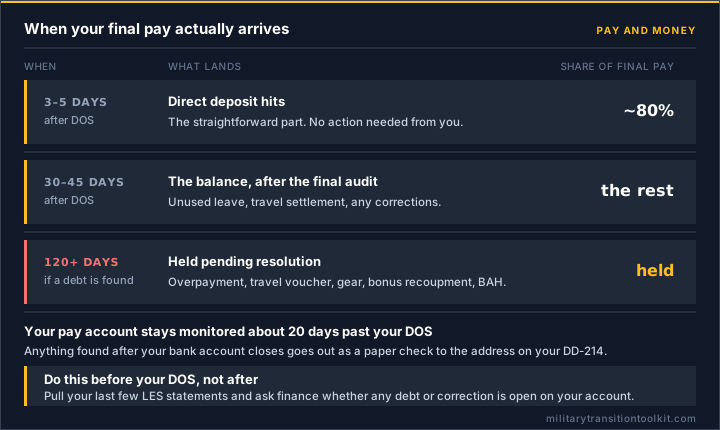
When you separate, your finance office closes out your pay account and sends your final entitlements via direct deposit (EFT). In a clean case:
- ~80% within 3-5 business days of your Date of Separation (DOS).
- The balance after the final audit, generally 30-45 days out.
- Your account stays monitored for roughly 20 days after DOS for any last adjustments. Residual payments found after your bank account closes may be mailed as a paper check to the address on your DD-214, so make sure that address is current.
The split exists because finance pays you the easy, certain portion fast, then audits the rest, leave balances, travel, any outstanding debts, before releasing the remainder.
What Pushes It to 120 Days
The audit is where final pay gets stuck. The most common cause is debt on your account, an overpayment, an unsettled travel voucher, equipment you owe for, a re-enlistment bonus recoupment, a housing or BAH adjustment. If the audit surfaces anything that has to be reconciled, your final payment can be held until it's resolved, and that can stretch 120 days or more from your separation date.
Free tool for this exact situation
VA claims, resume builder, MOS translator, career planner — all free.
This is the single most-overlooked transition risk, because nothing in out-processing warns you it's coming. You can do everything right and still wait months if there's a flag on your account you didn't know about.
Protect yourself before you separate: pull your last few LES statements and look for anything odd, a debt line, a negative leave balance, an allotment that shouldn't be there. Ask your finance office directly whether there are any open debts or pending corrections on your account. Clearing a $200 travel-voucher issue before DOS is far easier than chasing your whole final paycheck for four months after.
The Leave Sell-Back Piece
Unused leave is automatically sold back on your final paycheck, and it comes with rules people don't expect:
- You can sell back a maximum of 60 days of leave over your entire career, it's a lifetime cap, not per-separation. If you sold back 30 days at a prior re-enlistment, you only have 30 left.
- Sell-back is paid at your basic pay rate only, 1/30th of your monthly basic pay per day. No BAH, no BAS. Allowances are not included.
- It's taxable, expect about 22% federal withholding, plus any state tax.
That's also why the terminal-leave-vs-sell decision is really cash vs. time, not a pay difference: you draw full pay, BAH, and BAS until separation whether you take the leave or work and sell it. Selling adds a base-pay lump sum (withheld ~22%) for working those days; taking the leave gives you the paid days off — and the one way taking clearly wins on money is starting a civilian job while you're still on the rolls and collecting both paychecks. (See our Terminal Leave Guide and run your own numbers in the Terminal Leave Calculator.)
How to Plan Around It
- Build a cash reserve that doesn't depend on final pay. Most transition advisors recommend covering at least 60 days of expenses from savings before you separate, and that's separate from your last military check, not counting on it.
- Audit your own account before DOS. Pull your LES, hunt for debts or corrections, and ask finance to confirm a clean account in writing if you can.
- Confirm your DD-214 address. Residual payments and paper checks go there. If you are not sure what else on that form matters, the DD-214 explained walks the blocks that decide your benefits.
- Expect the gap between separation and your first civilian paycheck. New jobs often run 2-4 weeks to first pay, and that first check may be partial. Layered on a slow final military check, that's where people hit the wall.
- Track it. If your final pay hasn't fully landed by ~45 days, contact your servicing finance/pay office and ask specifically whether an audit flag is holding it.
The military won't shortchange you, your money will come. But "eventually" doesn't pay rent. Plan as if your final paycheck will be slow, and the timing stops being a crisis.
Sources: 37 U.S.C. § 501 — payment for unused leave (60-day lifetime cap), DFAS — Military Members pay, IRS Publication 15 (Circular E) — supplemental wage withholding. Confirm current rules against the official source before acting. This is general information, not financial, tax, or legal advice.
Military Transition Toolkit — free
Free financial planning tools for your transition
Budget Planner
Build a post-separation budget and compare military vs civilian income
Military Retirement Calculator
Model your TSP, pension, and retirement income side by side
All tools are 100% free. Create a free account to access account tools.
Related articles
How Terminal Leave and Leave Sell-Back Are Taxed (2026)
Taking terminal leave and selling leave back are taxed very differently. How each is treated, why sell-back is base pay only, and the combat-zone rule that lets you cash out leave tax-free.
Financial PlanningEmergency Fund for Military Families: How Much and Where to Keep It
Military life creates unique financial emergencies, PCS costs, deployment disruptions, gap periods at separation. Here's how to size and store your emergency fund for military-specific needs.
Financial PlanningHow to Report a Predatory Lender Targeting Military Members
If you've been targeted by a predatory lender or had your MLA rights violated, here's exactly how to file complaints and what happens after you do.
More free tools
Educational content, not professional advice
This article is published by Military Transition Toolkit for educational and planning purposes. It is not legal, medical, or financial advice. VA rating criteria, benefits, and regulations change — verify anything benefits-affecting against VA.gov, 38 CFR Part 4, or a VA-accredited representative (VSO, agent, or attorney) before filing.
MTT is an independent planning tool and is not affiliated with or endorsed by the Department of Veterans Affairs, the Department of Defense, or any military branch.