The DD-214 Cheat Sheet for Family Members: What Every Box Means and Why It Matters
The DD-214 controls every benefit you'll claim. What each block means, why character of discharge decides everything, and how to get a replacement copy.
The DD-214 (DD Form 214) is the official Certificate of Release or Discharge from Active Duty, the single document that proves when, where, and how a service member served. Nearly every veteran benefit depends on it, and its most important field is Block 24, Character of Service (Honorable, General, Other Than Honorable, Bad Conduct, or Dishonorable), which controls benefit eligibility. For VA purposes, use the long form, Member Copy 4.
The DD Form 214, usually just called the DD-214, is the most important piece of paper in a veteran's life. It's the official record of military service: when they served, where, what their job was, what awards they earned, and crucially, how they were discharged.
Almost every veteran benefit, from VA healthcare to GI Bill to home loans to job preference points, depends on what's on this form. Family members who can read it know more about their veteran's service and benefits eligibility than most veterans themselves do.
This guide walks through what each box means, what to look for, and how to get a copy if it's lost.
What the DD-214 is and isn't
It is: the official certificate of release or discharge from active duty. Issued at separation. Carries through life as the primary proof of service.
It isn't: an evaluation of the veteran's career. It's a summary, not a story. Two veterans with similar service can have different-looking DD-214s based on the issuing command, the era, and what they happened to be doing on separation day.
There are typically two versions:
- Member Copy 4 (or sometimes 1), the "long form" that includes character of service, narrative reason for separation, and reentry code. This is what's needed for most VA benefits applications.
- Member Copy 2 or 3 (sometimes called "short form"), a less-detailed version that omits some sensitive fields. Useful for routine employment verification but not always sufficient for VA purposes.
When in doubt, the long form (Member Copy 4) is what you want.
Reading the DD-214 box by box
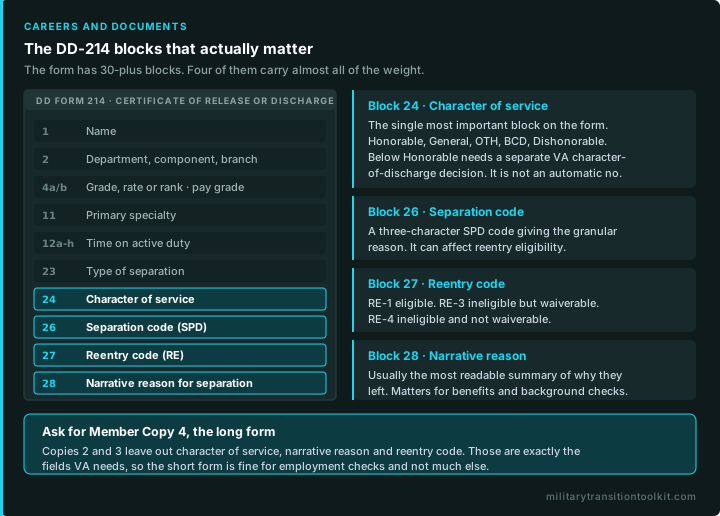
The form has 30+ blocks. Most family won't need to know all of them. Here are the ones that matter most (our DD-214 decoder is a plain-English guide to what each block means, including the separation, reentry, and specialty fields):
Block 1: Name
Last, First, Middle. Should match the veteran's legal name at separation.
Block 2: Department, Component, Branch
Active component vs. Reserve vs. National Guard. Branch of service. Important for benefit eligibility, Reserve and Guard time without active duty deployments triggers different benefit calculations.
Block 3: Social Security Number
Sensitive. Family handling DD-214s should redact this when sharing copies.
Block 4a/4b: Grade, Rate or Rank / Pay Grade
The veteran's rank at separation. E-5 Sergeant, O-3 Captain, etc. Affects retirement pay calculations and some benefit thresholds.
Block 5: Date of Birth
Block 6: Reserve Obligation Termination Date
For most active-duty veterans there's a Reserve component obligation that lasts after active separation, often until 8 years after enlistment date. This is when that obligation ends.
Block 7: Place of Entry into Active Duty / Home of Record
Where they enlisted from / their declared home of record. The home of record affects some state benefits.
Blocks 8-10: Stations, Last Duty Assignment
Where they were stationed at separation, and the unit and command.
Block 11: Primary Specialty
The MOS / AFSC / NEC / Rate. The military job code. Critical for understanding what the veteran did. Don't assume, military code names can be misleading. A "Combat Medic" 68W and a "Medical Service Corps Officer" did very different things despite both being "medical."
The block lists primary specialty(ies) and the years/months in each. A veteran with a non-combat specialty who deployed multiple times will have those deployments shown elsewhere.
Block 12a-h: Time on Active Duty
The total active duty time, broken down by enlistment / extension / current term. The "total prior active service" line tells you how many years they served.
For retirement and benefit calculations, what matters: did they hit 20 years (eligible for retirement)? Did they have prior service that counts? Did they have inactive periods?
Block 13: Decorations, Medals, Badges, Citations, and Campaign Ribbons Awarded
This is one of the most-read sections. Lists every award and decoration the veteran earned. A few you might see:
- Campaign medals: Iraq Campaign Medal, Afghanistan Campaign Medal, Global War on Terror, Vietnam Service Medal, etc. These prove deployment and trigger many benefits (PACT Act presumptions, VA priority groups).
- Combat awards: Combat Action Badge, Combat Infantryman Badge, Combat Action Ribbon, Combat Medical Badge. These confirm combat exposure.
- Personal awards: Bronze Star, Silver Star, Purple Heart, others. Purple Heart specifically triggers benefits.
- Service awards: Good Conduct Medal, MUC, NUC, NDSM (National Defense Service Medal, almost everyone serving during a defined era gets this).
- Foreign awards: From other nations, common in joint operations.
This block tells you what the veteran's command thought worth recognizing. It's also useful for VA claims, campaign medals and combat awards are concrete proof of exposures the veteran can claim.
Block 14: Military Education
Formal military schools attended. Important for some benefits and for resume translation.
Block 15a-b: VEAP Contribution & High School Graduate
Block 15a records whether the member contributed to the Post-Vietnam Era Veterans' Educational Assistance Program (VEAP). Block 15b records whether the member is a high school graduate or holds an equivalent. It does not indicate commissioning source.
Block 16: Days Accrued Leave Paid
Terminal leave details. Tells you whether they sold back leave at separation.
Block 17: Member Was Provided Complete Dental Examination
Yes/no. Important for VA dental claims later.
Block 18: Remarks
The catch-all narrative. Service-specific shorthand and notes that didn't fit elsewhere. Often contains lists of duty stations and dates that aren't elsewhere on the form.
Block 19a-b: Mailing Address After Separation
Self-explanatory.
Block 20: Member Requested Copy 6 to Be Sent To
Veteran's selected state archive, the DD-214 is also filed with the state of residence at separation, which makes future copy retrieval easier.
Block 21: Signature
Veteran's signature.
Block 22: Official Authentication
Signed by the separating official. Authenticates the document.
Block 23: Type of Separation
What KIND of separation. Common values:
Free tool for this exact situation
VA claims, resume builder, MOS translator, career planner — all free.
- Release from Active Duty (RELAD)
- Discharge
- Retirement (different categories: regular, length-of-service, disability)
- Death
Block 24: Character of Service
This is the single most important block on the entire form. It controls the veteran's eligibility for almost every benefit. Possible values:
- Honorable, full benefits
- General (under honorable conditions), most benefits, with some exceptions
- Other Than Honorable (OTH), restricted; benefit eligibility depends on a separate VA "character of discharge" determination
- Bad Conduct Discharge (BCD), generally bars VA benefits with limited exceptions
- Dishonorable Discharge, bars most VA benefits
If the veteran's DD-214 says anything other than Honorable, the next steps are:
- Read our OTH and discharge upgrade posts
- Consider a discharge upgrade application
- Apply for a VA character-of-discharge determination separately
A less-than-honorable character does NOT mean the veteran has zero VA benefits. The VA does its own determination, and many veterans with OTH discharges are deemed eligible for VA care anyway. But the path is more complicated.
Block 25: Separation Authority
The regulation under which the veteran was separated. Officer/enlisted-specific, branch-specific, situation-specific.
Block 26: Separation Code (SPD)
A 3-character alphanumeric code that gives more granular reason for separation. Common ones:
- JFY (involuntary separation, expiration of term)
- MBK (completion of required active service, standard end-of-term-of-service)
- KFB (medical retirement)
- LBK (administrative separation)
- JKQ (failure to meet weight standards)
- And many more, there are hundreds of SPD codes
The SPD code can affect things like reentry eligibility and some benefits. Worth looking up if it matters.
Block 27: Reentry Code (RE Code)
Whether the veteran is eligible to reenlist. Codes:
- RE-1, Eligible to reenlist
- RE-2, Ineligible (specific meaning varies by branch and era)
- RE-3, Ineligible due to a disqualifying factor that is waiverable — may return with an approved waiver
- RE-4, Ineligible, not waiverable (permanent)
Important for veterans considering returning to service, and sometimes for federal employment preference.
Block 28: Narrative Reason for Separation
A short text explanation. "Completion of required active service." "Disability, permanent." "Misconduct, drug abuse." "Failure to meet retention standards."
This is often the most readable summary of why the veteran left, and it matters for benefits, employment background checks, and discharge upgrade strategy.
Block 29: Dates of Time Lost
Time the veteran was AWOL, in confinement, or otherwise not credited toward service. Most DD-214s show "0" here.
Block 30: Member Requests
Specific requests from the veteran during separation processing.
Why character of discharge controls everything
The single most important question for any veteran's benefit eligibility is what's in Block 24. Honorable opens every door. General opens most. OTH triggers a separate VA determination process. Bad Conduct or Dishonorable closes most doors.
If the veteran in your life has anything below Honorable, that's the place to focus first. Discharge upgrade boards exist (Discharge Review Board, Board for Correction of Military Records) and have time limits, a Discharge Review Board claim must be filed within 15 years of separation, while BCMR has more flexibility.
How to get a copy of the DD-214
If the veteran has it
Make digital copies. Save them in multiple secure locations. The original paper form is essential and irreplaceable; if it's lost, replacement involves federal records requests.
If the veteran lost it (or family needs a copy and doesn't have one)
The form can be requested from the National Archives (National Personnel Records Center) using SF-180. The veteran can request their own copy free; family members typically need the veteran's permission, except for next-of-kin in certain situations.
Online: archives.gov/veterans/military-service-records (eVetRecs)
By mail: SF-180 to the National Personnel Records Center.
Turnaround: weeks to months, depending on era. Records from before 1973 had a fire that destroyed many files; reconstruction is sometimes possible but slower.
If the veteran is deceased
Next of kin can request DD-214 directly. The relationship to the deceased and proof of death (death certificate) are required.
State copies
Many states' veteran affairs offices keep DD-214 copies. Check whether the veteran's state of residence at separation has a state-level archive that can provide a copy faster than the National Archives.
What to do once you have it
If you have a copy of the DD-214 in your hand and you're family of the veteran:
- Confirm character of discharge in Block 24.
- Note campaign medals and combat awards in Block 13, these power claims.
- Note Block 11 specialty, this is what their resume should reflect (translated).
- Note Block 12 dates, total active service determines retirement eligibility.
- Make digital backups. Multiple. The veteran will lose theirs eventually.
Frequently Asked Questions
What is the most important block on the DD-214?
Block 24, Character of Service, is the single most important field. It controls eligibility for almost every benefit, with possible values of Honorable, General (under honorable conditions), Other Than Honorable, Bad Conduct, or Dishonorable.
What is the difference between Member Copy 4 and the short form?
Member Copy 4 (the "long form") includes character of service, narrative reason for separation, and reentry code, and is what most VA benefit applications require. The short form (Member Copy 2 or 3) omits some sensitive fields and is fine for routine employment verification but not always sufficient for VA purposes.
How do I get a replacement DD-214?
Request it from the National Archives (National Personnel Records Center) using Standard Form SF-180, or online through eVetRecs at archives.gov/veterans. The veteran can request their own copy free; family members usually need the veteran's permission, except next-of-kin in certain situations. Turnaround runs from weeks to months.
Does an Other Than Honorable discharge mean no VA benefits?
Not necessarily. An OTH triggers a separate VA "character of discharge" determination, and many veterans with OTH discharges are still found eligible for VA care. The path is just more complicated, and a discharge upgrade may be possible.
Which DD-214 blocks matter most for VA claims?
Block 24 (character of discharge) controls eligibility, Block 13 (medals and awards) documents campaign and combat service that powers claims and PACT Act presumptions, and Block 11 (primary specialty) shows what the veteran actually did.
What to remember
The DD-214 is two pages of bureaucratic shorthand that controls a lifetime of benefits. Family members who understand it can advocate, troubleshoot, and help the veteran navigate the systems that depend on it. The single most consequential piece of information is Block 24 (character of discharge). The single most useful for understanding the veteran's actual service is Block 11 (specialty) plus Block 13 (awards).
If you're holding a DD-214 you don't fully understand, this guide should at least let you read it. The veteran in your life has been carrying this paper for years. Know what it says.
National Archives veteran records: archives.gov/veterans. SF-180: standard form for record requests.
Sources: National Archives Military Service Records, VA.gov.
Military Transition Toolkit — free
Free tools for your military transition
MOS / AFSC Translator
Convert your military role to civilian job titles and salary data
Military Resume Builder
Translate military experience into language civilian employers understand
VA Combined Rating Calculator
Calculate your combined VA rating the same way VA does
All tools are 100% free. Create a free account to access account tools.
Related articles
Holidays, Deployment Anniversaries, and KIA Dates: The Calendar of Hard Days
There are predictable hard days in a veteran's year. Knowing the calendar in advance lets family show up the right way before the wave hits, instead of reacting after.
Family SupportHow to Support a Service Member's Transition: A Family Guide
For parents, adult children, siblings, and family members of separating service members. What to do at each stage of the transition timeline, how to bring up VA claims without nagging, and the emotional realities to expect.
Family SupportPTSD vs. Moral Injury vs. Survivor's Guilt: Why 'Talk to Someone' Lands Wrong
Three different things that look similar from the outside and need very different responses. What family should know about each, why the wrong framing makes it worse, and what to say instead.